
Fiber-optic broadband uses thin strands of glass or plastic to transmit data as pulses of light. This physical medium often replaces or supplements copper lines to carry large volumes of data with low electrical interference. Service offerings vary by how close the fiber terminates to the end user and by the networking architecture used at the provider’s core. Understanding those distinctions helps clarify why some installations deliver symmetric upload and download speeds while others combine fiber with existing copper or coaxial segments.
Providers typically describe networks by the point where fiber ends relative to a building or household: directly to the residence, to a building distribution point, to a neighborhood cabinet, or to a node further away. The underlying optical technologies—such as shared passive optical networks or dedicated active fiber—may affect bandwidth sharing, latency, and equipment needs. Service terms, installation complexity, and equipment responsibilities also often differ according to the connection type and architecture chosen.
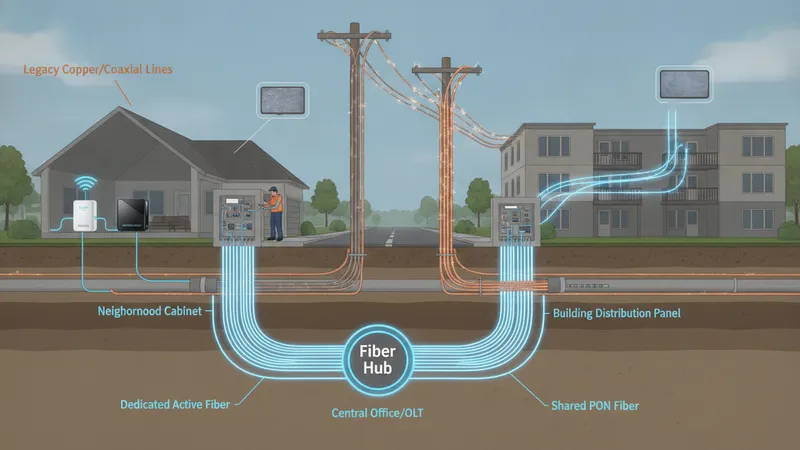
Comparing these examples, FTTH/FTTP often provides the simplest path to high symmetrical bandwidth because fiber extends to the premises and uses an optical network terminal there. FTTB may deliver similar optical capacity to a building but rely on in-building wiring that can affect achievable rates at individual units. FTTC and FTTN typically make use of legacy copper or coax for the last leg, which can impose distance-related attenuation and lower upload capacity. The choice of architecture may influence whether a service plan advertises symmetrical or asymmetric bandwidth.
The contrast between PON and active Ethernet architectures can be informative for technical planning. PON implementations use optical splitters to share a single fiber upstream across multiple subscribers, which may mean shared upstream or downstream capacity during busy periods. Active Ethernet provides a dedicated fiber path per endpoint but requires powered equipment and switch infrastructure in the provider’s network. Each approach may lead to different operational costs and maintenance arrangements for the operator and different performance profiles for end users.
Installation and customer premises equipment also vary by connection type. FTTH typically requires an optical network terminal (ONT) mounted at the premises and a router to create a local network; the ONT may be customer-owned or provider-supplied under a service agreement. For FTTB, a building aggregation device may be installed in a communications closet, and individual units connect via existing copper or structured cabling. For FTTC/FTTN, technician visits often focus on the cabinet and the transition from fiber to copper. Installation timelines and on-site access requirements can differ accordingly.
Service terms such as bandwidth tiers, data usage policies, and contract length may be tied to the physical connection and architecture. Providers may offer plans with gigabit-class downstream speeds for FTTH deployments and more limited upload rates or data allowances where copper remains in the last segment. Pricing structures often reflect installation complexity and equipment provisioning. When assessing options, it can be useful to compare technical and contractual elements together rather than relying on a single metric.
In summary, variants of fiber deployment differ by where optical fiber terminates (home, building, cabinet, or node) and by whether the network uses shared or dedicated fiber architecture. These distinctions typically influence achievable speeds, latency, equipment needs, and installation requirements. The next sections examine practical components and considerations in more detail.
Definitions for common connection types inform expectations about performance and installation. FTTH/FTTP places fiber directly to an individual unit, which often reduces signal conversion points and supports symmetric bandwidth. FTTB brings fiber to a building’s distribution point; the in-building medium—copper phone lines, coax, or Ethernet—then determines final delivery characteristics. FTTC and FTTN terminate fiber at a street cabinet or node and rely on existing metallic wiring for the remaining distance; this last-mile medium often imposes greater variability in achievable rates, especially over longer runs. Understanding these practical differences helps set realistic service expectations without assuming specific speeds.
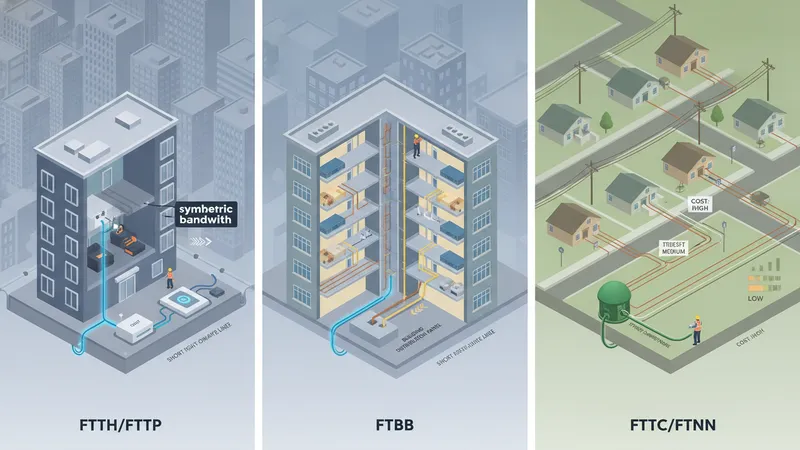
Deployment choices are frequently influenced by density and cost considerations. In dense urban or new-build scenarios, extending fiber to individual premises may be more feasible because of shorter distances and consolidated rights-of-way. In suburban or rural areas, reaching every premises with individual fiber may require higher capital investment per subscriber, so providers may initially choose cabinet or node-based solutions that reuse existing wiring. These deployment patterns often shape availability timelines and the technical characteristics of plans offered in different neighborhoods.
From a maintenance perspective, fiber-to-premises runs reduce the number of transitional interfaces and therefore the number of potential failure points inside the access network, although outside plant issues such as fiber cuts or joint failures can still occur. Cabinet- or node-based models concentrate service conversion equipment in street-level enclosures that may require distinct cooling, power, or access arrangements. Operators typically balance those operational considerations with expected subscriber counts when selecting a deployment approach for a specific area.
For end users and building managers, the visible implications include where the ONT or distribution equipment is located, whether internal wiring upgrades may be required, and whether any building-wide coordination is needed for installations. Property-level constraints—such as shared comms closets, conduit access, or historical wiring—can influence how quickly a particular connection type can be completed. These logistical factors are part of the practical differences among connection types and are worth documenting when comparing options.
Two common architectures in optical access are passive optical networks (PON) and active Ethernet. PON uses passive splitters to divide a single fiber’s optical signal among several endpoints, reducing fiber counts and often lowering deployment capital for providers. Active Ethernet assigns a dedicated fiber per subscriber and requires powered switching equipment in the operator’s exchange. Equipment at the premises commonly includes an ONT to terminate the optical signal and a router to handle local-area networking; responsibilities for ownerhip and support of that equipment depend on the service agreement.
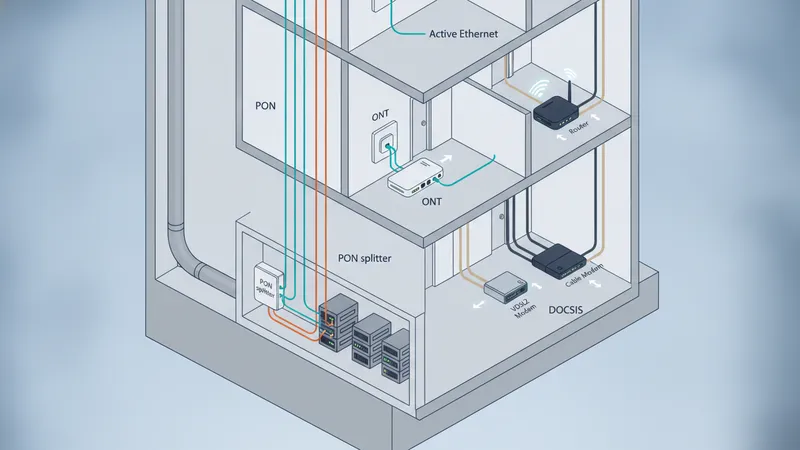
ONT placement and interface standards affect user experience and compatibility. The ONT typically provides Ethernet ports and possibly voice or coax outputs; it converts optical signals to electrical signals usable by a consumer router or existing wiring. In multi-dwelling configurations, a single building-level optical termination may feed a distribution switch or structured cabling system. When existing in-building copper is used, technologies such as VDSL2 or DOCSIS over coax may be used for the final leg, and the expected throughput will depend on the quality and length of that wiring.
Provider-side equipment also matters for scaling and service flexibility. OLTs (optical line terminals) in PON networks manage downstream and upstream scheduling and may support multiple split ratios; slotting and module choices influence how many users are served per port. Active Ethernet deployments require more fiber strands but can simplify provisioning of dedicated bandwidth per subscriber. Both architectures may support multi-gigabit upgrades through equipment changes at central offices and without replacing last-mile fiber in FTTH scenarios.
For consumers assessing equipment arrangements, considerations include whether the provider supplies and maintains the ONT and whether a separate router is permitted or required. Compatibility with existing home networks, voice services, and in-unit wiring is another factor. Where dedicated fiber reaches the premises, users may see simpler upgrade paths to higher bandwidth tiers because the optical medium itself can support higher wavelengths and modulation schemes with appropriate terminal equipment changes.
Advertised bandwidth tiers describe maximum throughput under ideal conditions, but real-world performance can vary depending on several factors. Symmetric speeds—equal upload and download rates—are often achievable when fiber terminates at the premises and the provider’s core supports symmetric provisioning. Where fiber is shared (for example, in certain PON split ratios) or where copper is used for the last segment, peak throughput may be subject to contention during busy periods. Latency is generally lower on all-fiber paths compared with extended copper segments, but routing and peering arrangements in the broader internet path also contribute to end-to-end delay.
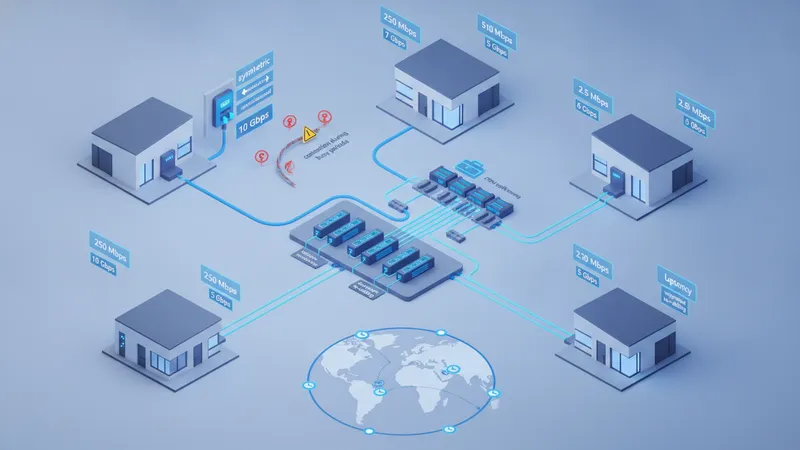
Typical plan ranges for fiber deployments may span from sub-gigabit packages to gigabit-class tiers and, in some areas, multi-gigabit offers such as 2.5 Gbps, 5 Gbps, or 10 Gbps. These tiers often depend on the provider’s equipment and the modulation schemes supported by ONTs and central office gear. When fiber reaches the premises, upgrades to higher tiers can sometimes be implemented via configuration changes or a single equipment swap rather than physical re-cabling, which may make higher-speed options more practical over time.
Network congestion, local wiring quality, and in-premises equipment can each affect observed speeds. Shared Wi‑Fi performance, for instance, can limit throughput independent of the wired service rate; using wired Ethernet connections typically provides more consistent results for speed tests. Providers may also apply traffic management policies or rate-limiting for certain services; reviewing service documentation can clarify whether any such policies apply and how they might influence typical usage patterns.
For end users, matching bandwidth expectations to typical household or business usage patterns is useful. High-bandwidth activities—such as multiple simultaneous 4K video streams, large file uploads, or cloud backups—can benefit from symmetric and higher-capacity links, while less demanding use cases may not require the same tier. Considering both peak speed needs and concurrent device counts helps frame which connection types and architectures may best align with operational requirements.
Availability of specific fiber connection types varies by geography, regulatory environment, and provider investment priorities. Deployments that extend fiber to premises may be prioritized in new developments or high-density zones, while cabinet/node-based solutions may appear earlier in areas where reuse of existing infrastructure reduces initial cost. When comparing offers, note whether installation fees, recurring equipment rental, and maintenance responsibilities are itemized separately; these components can materially affect total ongoing expense even if headline bandwidth figures appear similar.
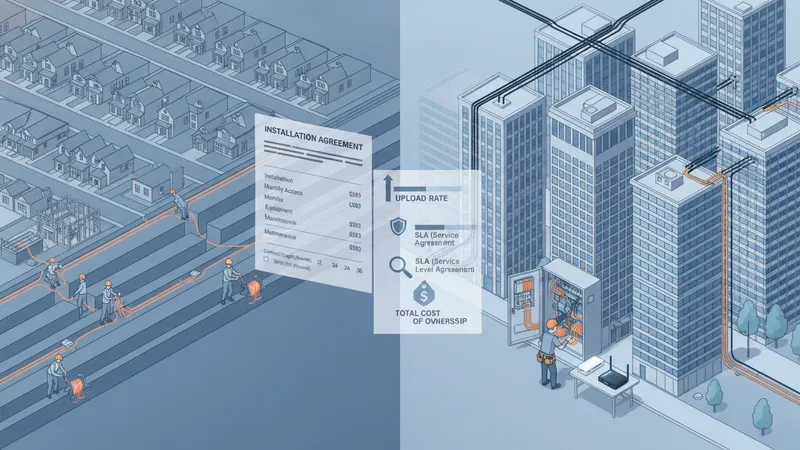
Pricing models typically include one-time installation charges, monthly recurring access fees, possible equipment rental, and optional service add-ons. Contract terms may specify minimum commitment periods and outline conditions for equipment return or transfer. Some providers may offer non-contract, month-to-month options, while others include fixed-term agreements; these choices can influence the total cost of ownership and should be weighed alongside technical factors like achievable upload rates and SLAs where applicable.
Comparative assessment benefits from looking at technical and contractual details in tandem. For example, FTTH often reduces the likelihood of speed degradation due to last-mile copper, possibly improving consistent throughput, while FTTB may require internal wiring upgrades to reach the same per-unit performance. FTTC/FTTN solutions may offer more rapid initial availability in some neighborhoods but may require planning for eventual full-fiber upgrades if higher symmetric capacities are needed in the future.
When documenting options, include installation windows, required in-unit access, expected lead times for upgrades, and any stated maintenance or outage procedures. Comparing these operational aspects alongside bandwidth profiles and equipment responsibilities provides a fuller picture of how each connection type aligns with technical and organizational needs. This integrated view supports a measured decision-making process without prescriptive recommendations.