
Selecting an industrial supplier for conveyor equipment involves a technical evaluation of products and services that support material movement in manufacturing or distribution. This concept covers assessment of physical system designs, expected load profiles, material contact compatibility, control and automation capabilities, and the supplier’s capacity to provide engineering support. Attention is often given to installation services, spare parts availability, maintenance offerings, and alignment with relevant industry standards. The process typically balances immediate functional needs with projected operational life and adaptability to changing production requirements.
Comparisons among conveyor equipment suppliers commonly consider both product attributes and service scope. Technical criteria may include belt or chain types, frame materials, drive arrangements, and modularity. Service criteria often address delivery timelines, on-site assembly, commissioning support, training, and warranty terms. Procurement teams may use formal requests for information or proposals and may request factory acceptance testing or on-site demonstrations to verify performance under representative conditions. Financial factors such as total cost of ownership can be part of the evaluation without implying predictable outcomes.
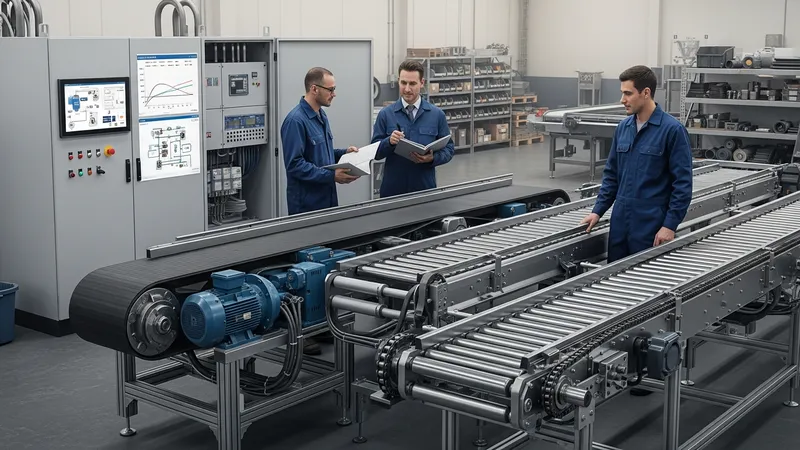
When comparing suppliers on system design and engineering support, buyers may examine how manufacturers translate process requirements into mechanical and control specifications. Suppliers typically provide technical drawings, load calculations, and layout proposals that indicate clearances, drive power, and structural support. Engineering depth can influence how well a supplier adapts standard modules to site constraints and how they account for thermal expansion, vibration, or floor flatness. These are factual considerations that can affect procurement timelines and the degree of on-site modification required.
Load capacity and material compatibility are frequently assessed through metrics such as maximum conveyed mass per unit time, belt width, line speed, and peak point loads. Different materials—powders, granules, sheets, or packaged goods—may require distinct belt materials, cleats, or containment features. Environmental factors like temperature, humidity, dust, and chemical exposure often inform material choices and protective coatings. Suppliers can usually provide typical capacity ranges and suggest component ratings, but final selection should be tied to measured or estimated process parameters.
Customization and automation features influence both functionality and lifecycle outcomes. Some suppliers provide modular platforms with configurable frame lengths, while others offer bespoke engineered solutions for unusual footprints or interfaces. Automation options commonly include variable-frequency drives, PLC-based sequence control, proximity sensing for accumulation, and integration points for higher-level supervisory systems. Software compatibility, data output formats, and maintenance access are technical aspects that may be specified to ensure long-term operability and integration with existing controls.
Maintenance support, spare parts logistics, and installation services are practical supplier capabilities often examined in parallel with equipment specifications. Suppliers may provide installation teams or supervised installation plans, preventive maintenance schedules, and spare-part kits sized to expected wear items. Lead times for critical components and availability of technical documentation such as wiring diagrams and parts lists can affect downtime risks. Considering these factual service elements helps purchasers form a more complete view of operating costs and reliability without implying guaranteed performance.
In summary, evaluating conveyor equipment suppliers requires a structured look at mechanical design, load and material handling characteristics, options for customization and automation, and the supplier’s installation and after-sales support. These elements collectively influence lifecycle cost, operational fit, and future adaptability. The next sections examine practical components and considerations in more detail.
Different conveyor types address distinct handling needs, and suppliers often present comparative data to match system types to application profiles. Belt conveyors may be specified for continuous, uniform transport and can vary by belt material for abrasion or food-contact compatibility. Roller conveyors typically suit discrete unit loads and may incorporate powered rollers or gravity sections. Modular plastic chain conveyors are commonly used where sanitary cleaning and complex routing are priorities. Suppliers may provide reference layouts, standard module dimensions, and nominal performance curves that illustrate how each system type behaves under typical operating conditions.
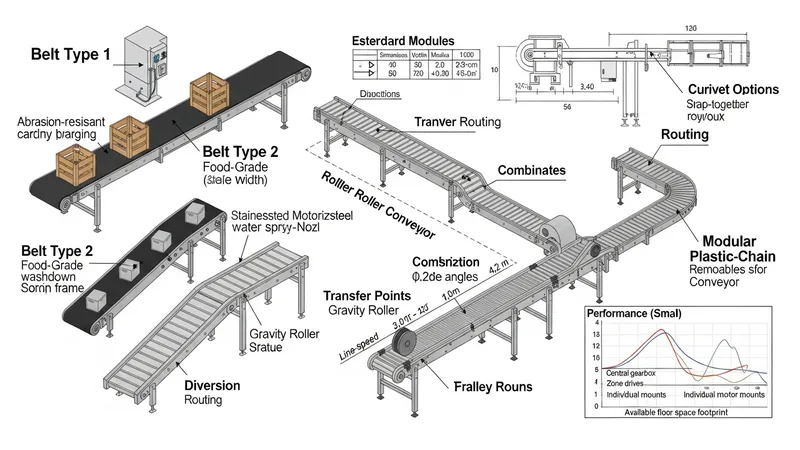
Design considerations frequently include belt or chain width, line speed range, incline capability, required transfer points, and available floor space. Suppliers typically offer standard widths and speeds with options to customize for atypical shapes or clearances. Drive selection—central drive, zone drives, or individual motor drives—can affect maintenance access and control complexity. Structural design addressing load distribution, support spacing, and mounting methods is often documented in drawings; purchasers may request finite-element or deflection data for critical spans where product orientation is sensitive to vibration or sag.
Material selection for belts, rollers, and structural elements often depends on contact requirements and environmental exposure. For example, food industry installations may require FDA-compliant belt materials and stainless-steel frames, while abrasive bulk handling may favour reinforced belts and hardened rollers. Suppliers generally indicate typical material options and their trade-offs in terms of wear resistance, cleanability, and cost. Design for maintainability—such as access panels, quick-change modules, and standardized fasteners—may be included as part of product families to reduce servicing time.
An important consideration is how easily a chosen system type integrates with upstream and downstream equipment. Transfer chutes, feed hoppers, sortation interfaces, and pallet handling stations can introduce alignment and timing constraints. Suppliers may provide control interface specifications and mechanical tolerance envelopes to aid integration planning. Including these interface details early in the design stage can clarify whether a modular solution or a custom-engineered conveyor is more appropriate, expressed as a practical trade-off rather than a prescriptive recommendation.
Assessing load capacity involves translating process throughput into peak and average loads the conveyor must withstand. Suppliers often present capacity as mass per linear metre or tonnes per hour, accompanied by recommended maximum belt tensions and motor power ranges. Duty cycles—continuous versus intermittent operation—can substantially influence component sizing and expected wear rates. Additionally, point loads from pallets or heavy containers may require reinforced frames or special support rails; these structural requirements are typically documented in supplier datasheets or engineering proposals.
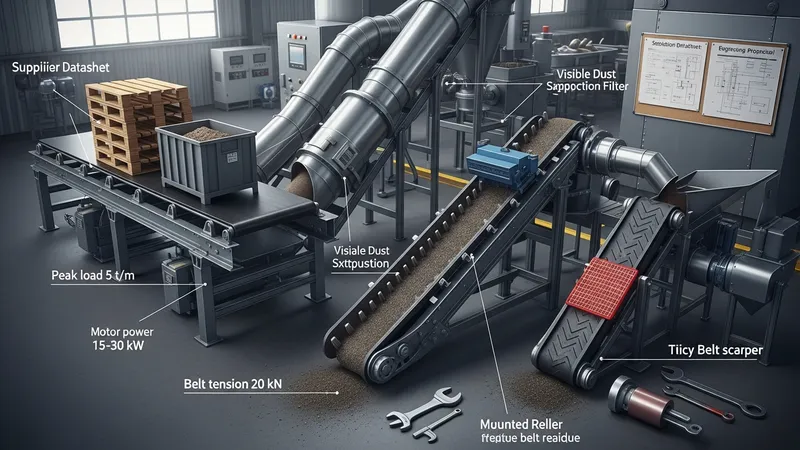
Material compatibility extends beyond simple abrasion characteristics to include particle shape, moisture content, electrostatic behaviour, and risk of segregation. Conveying fine powders often requires enclosed or tubular solutions to limit dust, while sticky or cohesive materials may need belt scrapers, heated sections, or special coatings. Suppliers commonly list material handling limitations and suggest mitigation measures such as belt cleats, flighting, or vibratory aids. These factual considerations can influence both initial capital layout and long-term maintenance demands.
Environmental and safety-related structural requirements are also part of supplier assessments. Exposure to corrosive atmospheres, extreme temperatures, or washdown processes may drive material choices for frames and fasteners. Suppliers may offer different protection levels including surface treatments, stainless-steel grades, or encapsulated bearings. Structural design must account for anchoring to floors, seismic considerations in some regions, and alignment tolerances to prevent tracking issues. Such structural factors are technical inputs to procurement specifications rather than guarantees of site performance.
Drive and support component selection ties directly to capacity and structural design. Motor sizing, gearbox ratios, and bearing types are selected to accommodate starting torque, slope resistance, and expected shock loads. Suppliers often provide typical motor ratings and gearbox configurations for given capacities and may note when regenerative braking or soft-start controls are advisable. These details help quantify expected electrical demand and maintenance intervals, forming part of a realistic lifecycle perspective when comparing supplier offers.
Automation features offered by conveyor suppliers frequently include variable-speed drives, programmable logic controllers (PLCs), sensor-based accumulation, and human-machine interfaces (HMIs). Suppliers may present standard control packages that handle basic sequencing and safety interlocks, with options for expanded I/O or communication protocols such as Ethernet/IP, Profinet, or Modbus. Integration with higher-level systems like manufacturing execution systems (MES) or warehouse management systems (WMS) is often a compatibility consideration; suppliers might document supported protocols and typical data outputs to aid system integration planning.
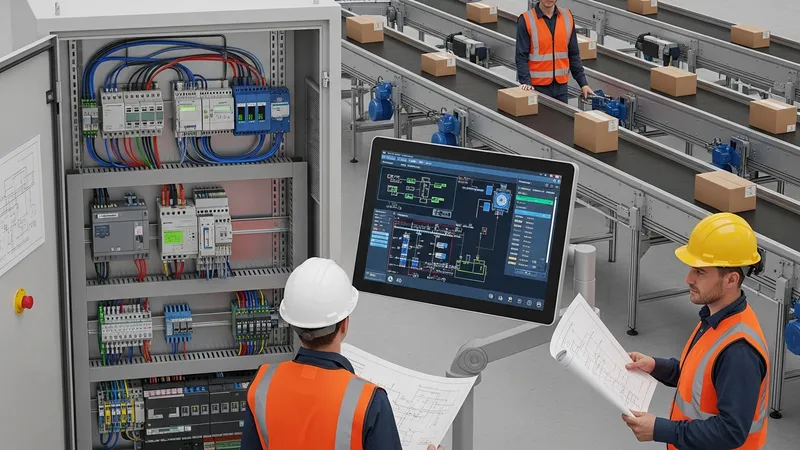
Control customization can range from parameter-adjustable controllers to fully bespoke software for complex sequencing or sorting logic. Suppliers may offer modular control cabinets that match conveyor zoning and allow for phased installation. When considering customization, purchasers often weigh the benefits of tailored functionality against increased commissioning time and documentation needs. Suppliers typically provide example ladder logic, I/O lists, and wiring diagrams that illustrate how custom control elements are implemented, which can help technical teams evaluate integration effort.
Safety-related control features are a consistent part of supplier offerings and include emergency stop circuits, safety-rated speed monitoring, light curtains at access points, and guarded transfer areas. Suppliers commonly reference safety standards and provide options for safety controllers and category-rated circuits. These elements may affect layout and enclosure choices as well as service access. Suppliers frequently document typical safety arrangements and may indicate which elements are part of standard packages versus optional extras, allowing purchasers to compare the scope of included safety controls.
Customization for mechanical routing, infeed/outfeed interfaces, and modular expansion is another area where suppliers vary. Some manufacturers emphasize a catalogue of interchangeable modules that simplify reconfiguration, while others provide fully engineered solutions for unique footprints. Considerations such as spare-parts commonality, ease of field modification, and the degree of on-site assembly required are factual factors that can be compared. Suppliers generally supply drawings and bills of materials that clarify modularity and long-term adaptability.
Installation services and their scope are commonly detailed by suppliers and may include site surveys, anchoring, commissioning, and operator familiarisation. Some suppliers provide full turnkey installation while others supply equipment plus installation documentation. Documentation quality—wiring diagrams, exploded parts lists, maintenance manuals—can affect the speed of commissioning and future troubleshooting. It is typical for purchasers to request clarity on which installation tasks are included and which are the responsibility of the buyer or a third-party contractor, stated here as factual distinctions rather than prescriptive advice.
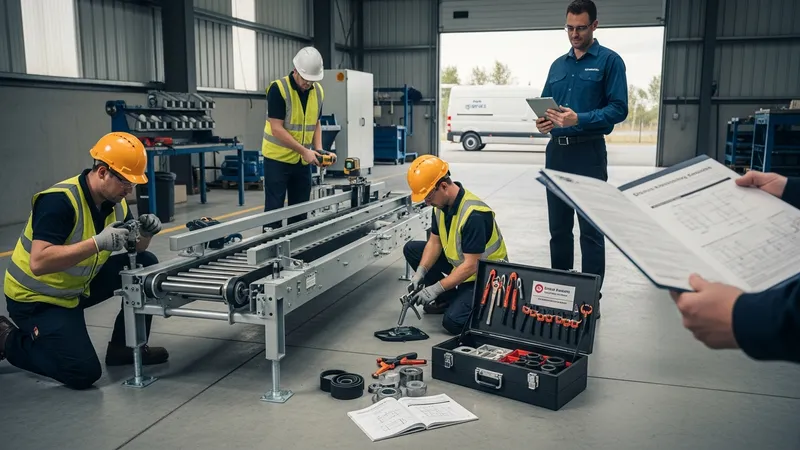
Maintenance regimes and spare-parts strategies are practical aspects to consider when comparing suppliers. Routine tasks such as belt alignment, bearing lubrication, and drive checks are often specified in supplier maintenance manuals with suggested intervals depending on duty. Suppliers may offer spare-parts kits for wear items and indicate typical replacement intervals for belts, rollers, and bearings. Knowledge of expected lead times for critical spares and availability of local service technicians can influence operational downtime exposure and inventory planning.
Lifecycle cost considerations extend beyond purchase price to include energy consumption, scheduled maintenance, expected component replacement frequency, and potential retrofits. Suppliers may supply estimated operating power and typical service life for key components under stated operating conditions. These estimates can be used to model comparative lifecycle scenarios, acknowledging that actual outcomes may vary with use patterns. Information such as typical motor efficiency, gearbox service intervals, and belt degradation patterns is often supplied to support such analysis.
Supplier support channels and documentation practices vary and can impact long-term operability. Availability of technical support, remote diagnostic capabilities, training offerings, and structured handover documentation can influence how quickly faults are resolved. Some suppliers may also provide modernization or retrofit options to update controls or replace wear components as needs evolve. These support-related details help create a practical picture of expected service levels and equipment evolution over time without implying assured results.