
Energy transition investment refers to the financing approaches and capital structures used to support the shift from high-carbon energy systems to lower-carbon alternatives. It encompasses funding for renewable electricity generation, energy storage, grid modernization, energy efficiency upgrades, and related infrastructure that reduce greenhouse gas intensity. The concept brings together project-level financing, corporate finance, public finance, and market-based instruments to mobilize capital at scale while addressing technical, regulatory, and revenue risks associated with long-lived energy assets.
Actors in energy transition investment typically include commercial banks, institutional investors, development finance institutions, utilities, and specialized debt or equity funds. Financing strategies may combine debt, equity, mezzanine instruments, green-labelled bonds, and blended finance approaches that use concessional capital to improve commercial viability. Investment decisions often hinge on revenue certainty, offtake arrangements, regulatory stability, and technology readiness, with due diligence that integrates technical, environmental, and financial assessments.

Different financing instruments can serve distinct stages of low-carbon infrastructure development. For early-stage technology pilots, subordinated equity or grants may typically play a larger role, while construction and operation phases often rely on senior debt and long-term contracts. Project finance structures can isolate project risk but may require detailed contractual security such as collateral, escrow accounts, and step-in rights. Green-labelled debt instruments may attract investors focused on environmental objectives, yet such instruments often require transparent use-of-proceeds reporting and alignment with recognized taxonomies or principles.
Risk allocation is central to structuring low-carbon infrastructure finance. Construction risk, technology performance risk, market-price volatility, and regulatory changes can each affect project viability. Contracts such as fixed-price engineering, procurement and construction agreements, long-term offtake contracts, and availability-based payments can shift particular risks to parties best able to manage them. Lenders and investors frequently seek covenants and contingency mechanisms that may include reserve accounts, insurance policies, and contractual triggers to address cost overruns or revenue shortfalls.
Policy and regulatory context often influences financing costs and capital availability. Predictable tariff regimes, clear permitting processes, and established interconnection rules typically make projects more bankable, while uncertain or rapidly changing policy environments may increase perceived risk and financing spreads. Public support mechanisms — including guarantee facilities, tax credits, or capacity payments — can reduce the effective cost of capital for certain projects, though such measures may vary by jurisdiction and time horizon. Market design that values flexibility and ancillary services may also affect the attractiveness of storage and grid investments.
Monitoring, reporting, and verification frameworks may often be incorporated into financing documents to track environmental performance and compliance with sustainability criteria. Investors increasingly request measurable metrics and regular disclosure on emissions, asset utilization, and environmental and social safeguards. Independent technical advisers, third-party verification, and standardized reporting protocols can support transparency and investor confidence without implying guaranteed outcomes. These processes typically complement financial covenants and project-level governance arrangements.
In summary, energy transition investment combines a range of financing tools and contractual arrangements to support low-carbon infrastructure development. Selection among instruments such as green bonds, project finance, and PPPs typically depends on project stage, risk profile, and policy context. Careful allocation of technical, market, and regulatory risks, together with robust monitoring and transparency, can shape investor participation and cost of capital. The next sections examine practical components and considerations in more detail.
Debt instruments commonly used for low-carbon infrastructure include green bonds, syndicated loans, project-level bank debt, and export-credit facilities. Green bonds typically designate proceeds for environmentally beneficial projects and often align with voluntary guidelines that require reporting on use of proceeds. Project-level bank debt and syndicated facilities may be structured with construction and term tranches to match cash flow timing. Equity financing ranges from sponsor equity to institutional equity funds that take longer-term exposures. The mix of debt, equity, and hybrid instruments often reflects risk allocation objectives and investor time horizons.
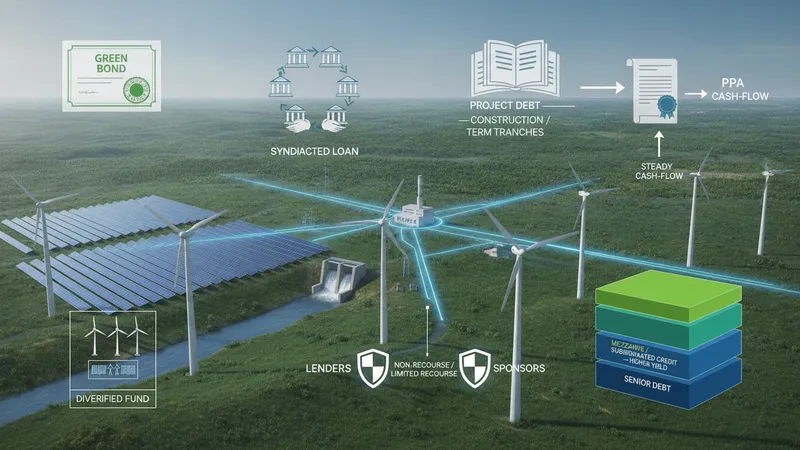
Project finance structures may typically rely on non-recourse or limited-recourse arrangements where lenders look primarily to project cash flows and contractual off-takers. In renewable power, long-term power purchase agreements (PPAs) often underpin revenue projections and can reduce offtake risk. Mezzanine finance and subordinated credit can bridge gaps between senior debt capacity and sponsor equity, often carrying higher pricing and different maturity profiles. Investors may also use funds that aggregate multiple projects to diversify asset-level risk across portfolios.
Blended finance approaches combine concessional capital or grants with commercial lending or equity to improve project bankability. Development finance institutions and philanthropic capital can provide first-loss capital, guarantees, or technical assistance that attract private investors by mitigating specific risks. Such mixes typically aim to mobilize follow-on private finance without implying performance guarantees; they may be structured to taper concessional support as projects mature or as markets develop.
Pricing and tenor patterns may vary by market conditions, asset class, and perceived risk. For example, mature renewable technologies in stable regulatory settings may often secure longer tenors and lower financing spreads compared with emerging technologies or jurisdictional risks. Lenders and investors commonly evaluate scenarios of future cash flows, sensitivity to market prices, and covenant structures when setting pricing. Clear contractual mechanisms and predictable revenue streams often influence financing terms more than promotional claims about a technology’s merits.
Risk assessment typically begins with identification of technical, commercial, and regulatory exposures. Technical risk covers construction timelines, technology performance, and integration with grid systems; commercial risk addresses demand, price volatility, and counterparty creditworthiness; regulatory risk includes permitting, tariff changes, and policy shifts. Quantitative risk matrices and scenario modelling are often used to estimate potential impacts on cash flow and debt service coverage, with sensitivity analyses to test key assumptions under different market conditions.

Contractual allocation of risks commonly uses instruments such as PPAs, construction contracts with liquidated damages, operation and maintenance agreements, and insurance. Power purchase agreements can transfer market risk to a counterparty if structured with fixed payments, while merchant exposure may remain where projects sell into spot markets. Construction contracts that include performance guarantees and milestone-based payments can reduce construction and commissioning uncertainties, though they may not remove all residual risks tied to supply chains or workforce availability.
Third-party risk mitigation tools are often used to enhance bankability. Political risk insurance, partial credit guarantees, and foreign exchange hedges can be relevant for projects exposed to currency or sovereign risks. Hedging instruments may cover commodity price exposure or interest rate risk on floating-rate debt. Lenders may require escrow accounts, debt service reserve funds, or sponsor support agreements to provide additional buffers against temporary revenue interruptions or cost overruns.
Due diligence often integrates technical reviews, environmental and social impact assessments, and legal reviews that verify contract enforceability and permitting status. Financial modelling commonly includes base-case and stress-case scenarios to examine debt service coverage ratios, equity internal rates of return under varied conditions, and covenant breach triggers. These practices typically inform negotiations over pricing, covenants, and triggers rather than offering assurances of future performance.
Public-private partnerships (PPPs) comprise a range of contractual models where public entities engage private parties for design, build, finance, operate, or transfer functions. In energy transition contexts, PPPs may be applied to grid upgrades, distributed energy resources, or large-scale storage facilities. Contract types can include availability payment concessions, revenue-sharing models, and build-operate-transfer arrangements. The selected model often reflects public objectives, fiscal constraints, and the degree to which revenue streams are predictable.

Procurement and allocation decisions in PPPs frequently prioritize clarity on performance metrics and payment mechanisms. Availability-based contracts pay for asset performance and uptime, which can be suitable for grid modernization projects where direct energy offtake contracts are less applicable. Concession agreements that tie payments to usage or tariff receipts may shift demand risk to the public counterparty or blend it across stakeholders. Transparent procurement processes and standard contract templates often reduce transaction costs and time to financial close.
Multilateral development banks, export credit agencies, and national financing facilities may participate in PPPs by providing long-tenor loans, co-financing, or partial risk guarantees. Such participation can lower perceived sovereign or market risk for private lenders, potentially improving access to capital for technically complex projects. However, the presence of public support does not eliminate project-level due diligence requirements; it typically complements commercial financing by addressing specific gaps or asymmetries in risk appetite.
Contractual provisions for operations and maintenance, performance-based incentives, and handback conditions are common components of PPP agreements. Clear definitions of responsibilities, performance measurement, and remedies for non-performance help maintain operational continuity across long-term contracts. Stakeholders often incorporate periodic reviews and renegotiation clauses to accommodate technological change or evolving regulatory frameworks, reflecting the long-lived nature of infrastructure assets.
Technical due diligence typically assesses resource availability, technology maturity, interconnection requirements, and project design. For renewable generation, resource assessments and yield estimates are central; for storage, cycling capacity and degradation profiles are key. Independent technical advisers often validate assumptions used in financial models, verify capex and opex estimates, and highlight integration or curtailment risks that may affect revenues. These findings commonly shape lenders’ conditions and pricing rather than providing guarantees.

Environmental and social assessments evaluate potential impacts on ecosystems, communities, and land use. Requirements may include baseline studies, mitigation plans, stakeholder engagement strategies, and ongoing monitoring. Investors increasingly consider environmental and social governance (ESG) factors as part of risk assessment, with metrics that may include emissions intensity, biodiversity impacts, and labor standards. Compliance with applicable standards and transparent reporting can influence investor interest and reputational risk assessments.
Financial modelling and stress testing are standard elements of diligence, examining cash flow projections under different scenarios for resource availability, market prices, and operating costs. Model inputs often incorporate assumptions on capacity factors, maintenance schedules, tariff escalators, and inflation. Sensitivity analyses on key variables — such as project yield or PPA price — frequently inform covenant thresholds, reserve requirements, and the structure of contingency mechanisms that lenders may request.
Monitoring, reporting, and independent verification practices can support continued investor oversight and public transparency. Measurement protocols for energy output, storage performance, and emissions reductions may follow recognized standards or third-party verification. Periodic reporting against agreed indicators helps stakeholders assess operational performance and compliance with financing conditions, while adaptive management provisions can enable technical or contractual adjustments over an asset’s life without implying fixed results.