
Many organisations assemble a unified software environment to coordinate tasks, data, and user interactions across departments. Such a platform typically groups modules for workflow orchestration, data management, user access, communications, and reporting so routine processes run more predictably. The focus is on reducing manual handoffs, centralising records, and enabling repeatable processes through configuration rather than bespoke code. A platform of this kind often supports role definitions, audit trails, and connectors to external systems to maintain continuity of operations across sales, operations, finance, and support functions.
Key design elements include clear process definition, configurable task rules, shared data schemas, and interfaces for integrations. Systems may expose visual workflow editors, scheduled or event-driven automation, and document repositories that preserve version history. Administrators often control permissions and retention policies while analytics modules provide operational visibility. Scalability and customization are common considerations: organisations evaluate whether the platform can adapt to changing process complexity and growing user counts without excessive rework.
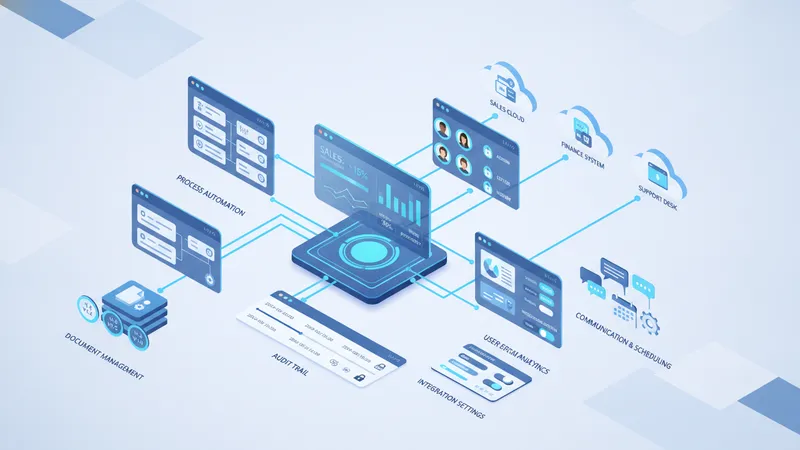
When comparing centralised versus federated platform approaches, several patterns appear. Centralised platforms consolidate functionality in a single environment, which can simplify governance and reporting but may require greater initial configuration. Federated approaches keep specialised tools in place and rely on integration layers, which can preserve existing investments yet introduce data synchronisation challenges. Organisations often weigh trade-offs around vendor lock-in, upgrade paths, and the effort required to map processes into a common model. Selection criteria commonly include interoperability, modularity, and the availability of administration and monitoring features.
Automation and task orchestration components typically follow deterministic rule engines or event-driven patterns. Deterministic engines apply pre-defined rules to route tasks and change states in a process; event-driven systems react to messages or external triggers and can be suitable for near-real-time needs. Both approaches may coexist: routine approvals may use rule-based flows while notifications and integration events use asynchronous messaging. Robust implementations often include retry logic, error queues, and audit trails so administrators can inspect and correct exceptions without disrupting upstream systems.
Data and information management functions are central to operational consistency. Platforms usually implement canonical data models or mapping layers to normalise incoming records from multiple sources. Access control is layered: role-based permissions, attribute-based constraints, and segregation of duties may be used together to limit exposure. Retention and archival features help satisfy record-keeping requirements while search and indexing capabilities support operational tasks. Data governance typically involves metadata management and periodic review of access privileges to reduce the risk of stale or excessive permissions.
Reporting, analytics, and dashboards provide visibility into process performance and resource utilisation. Common metrics include cycle time, task backlog, exception rates, and SLA compliance; these may be visualised at team, project, or organisational levels. Analytical modules often support ad hoc queries and scheduled reports, and they may export aggregated data to business intelligence tools for broader analysis. When designed for operations, reporting features typically include filters for time windows, user groups, and process stages to help identify bottlenecks and areas for incremental improvement.
In summary, a unified operational platform combines workflow control, customer and document management, access governance, and analytics to reduce manual coordination and improve traceability. Implementation choices may influence maintainability, integration complexity, and visibility into operations; common considerations include the balance between configuration and custom development, integration patterns, and administrative controls. The next sections examine practical components and considerations in more detail.
Core feature types often map to functional modules that address distinct operational needs. Workflow modules handle sequencing and human approvals; CRM-like components manage account records and interaction histories; document systems store and index records for retrieval and compliance; notification services relay status updates to stakeholders. Each module may expose configuration interfaces so non-developers can adjust rules or forms. When evaluating functionality, organisations often review how easily modules interoperate, whether data schemas are shared or require mapping, and the available tooling for monitoring process health and error conditions.
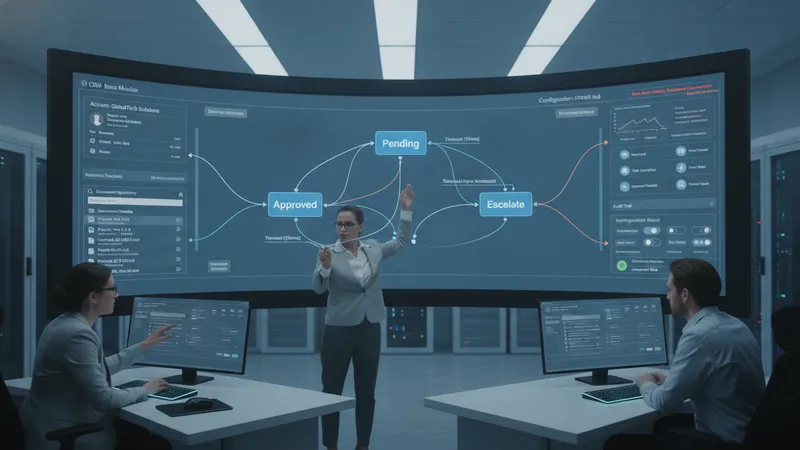
Workflow management commonly includes visual process editors and state machines for defining task lifecycles. Visual editors may reduce the need for code by allowing process owners to model flows, but they can impose constraints if complex logic is required. State machines enforce valid transitions and can include timeout handlers or escalation paths. Practical considerations include versioning of process definitions, the ability to run simulations or test cases, and whether historic executions are retained for audit. These features may be especially useful for regulated teams that need demonstrable process control.
Customer and account management modules typically store identifiers, contact histories, and relationship links to transactions or cases. These modules can often synchronise with external sales or billing systems via APIs or scheduled exports, preserving a single source of reference for operational users. Considerations include how duplicate records are detected and merged, the support for custom fields, and how interaction histories are indexed for search. In many organisations, having a coherent account model reduces repeated data entry and improves traceability across handoffs.
Document and record management subsystems usually provide searchable storage with metadata, version control, and retention settings. Metadata schemes may align with process stages to facilitate retrieval during case handling. Features to consider include support for scanned documents and OCR, automated classification, and the ability to link documents to specific process instances. Administrators often assess how retention and disposal policies are configured and whether legal holds or archive exports are supported for compliance purposes.
Access control is typically implemented through role-based models, sometimes supplemented by attribute-based rules for finer granularity. Roles may map to job functions such as case handler, supervisor, or auditor, and permissions control create, read, update, and delete actions on records and documents. Practical deployments often include audit logs that capture user actions and state changes for accountability. Organisations may also require multi-factor authentication for administrator access and periodic reviews of role assignments to prevent privilege creep over time.
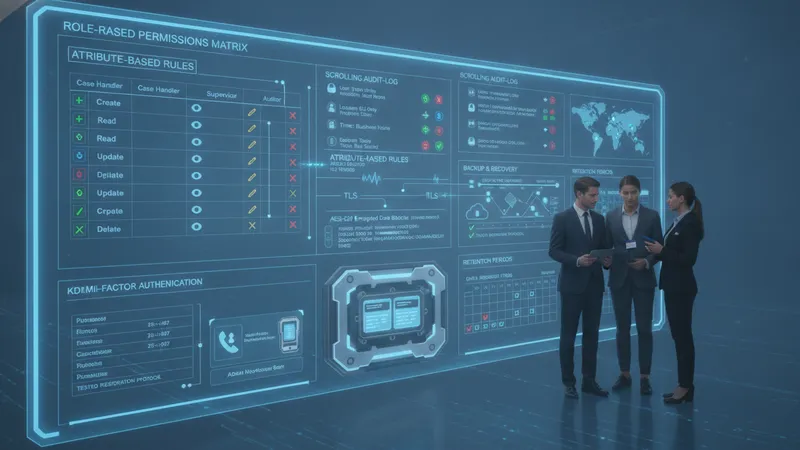
Data protection measures commonly include encryption at rest and in transit, tokenisation for sensitive fields, and secure key management. Backup and recovery procedures are critical for operational continuity; these often involve point-in-time backups and tested restoration workflows. Data residency and retention requirements can influence storage choices and archival frequency. When handling personally identifiable information, teams often apply minimisation principles and limit the retention period to what is necessary for operational or regulatory needs.
Compliance-related features may include configurable retention schedules, audit trails, and export capabilities for legal or regulatory review. Systems often provide access controls that support segregation of duties, enabling separate teams to perform complementary roles without unnecessary overlap. Practical considerations include maintaining attestable records of configuration changes and adopting change control practices so that policy updates are applied consistently and documented for future inspection.
Insider considerations include planning for incident response and role separation in administrative functions. For example, operational staff handling daily tasks may be distinct from those who manage system configurations, and separate credentials or roles can reduce the risk of accidental or malicious configuration changes. Regular reviews and simulated incident drills may help teams validate that controls and recovery mechanisms work as intended and that audit logs provide sufficient context for post-incident analysis.
Platforms often provide RESTful APIs, webhook endpoints, or message-based interfaces to connect with external systems. API design choices influence how easily developers can orchestrate cross-system workflows and automate handoffs. Well-documented endpoints and stable versioning practices may reduce integration effort and long-term maintenance. Considerations include rate limits, authentication schemes such as OAuth, and error-handling patterns. Organisations frequently adopt middleware or integration platforms to normalise payloads and manage retries and mapping logic between disparate schemas.
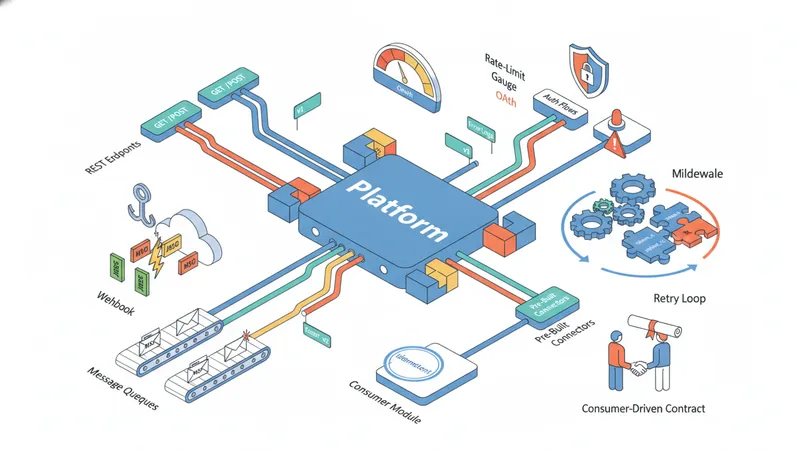
Connectors and pre-built integrations can accelerate adoption but may limit flexibility if they only cover standard use cases. Where bespoke integrations are required, common patterns include event-driven architectures with message queues and idempotent consumers to handle duplicates safely. API contracts should be explicit about expected payloads and side effects, and teams often establish consumer-driven contracts to help ensure changes do not introduce regressions in production environments.
Extensibility features such as plugin frameworks, scripting hooks, or low-code extension points allow organisations to adapt a platform without modifying its core. These mechanisms can support custom validations, field calculations, or integration adapters. When using extension points, it is prudent to maintain clear separation between custom extensions and core configuration so upgrades can proceed with minimal disruption. Versioned deployment practices and automated tests may help validate extensions across platform updates.
Insider tips include documenting integration flows and mapping logic, and storing transformation rules in a central repository. This practice can reduce onboarding time for new developers and make debugging easier when integrations fail. Teams often log correlation identifiers through end-to-end workflows to trace messages and actions across systems; such identifiers may be critical when investigating delays or data mismatches in operational processes.
System administration tasks commonly cover user lifecycle management, configuration of process definitions, performance tuning, and maintenance of integration endpoints. Administrators may schedule routine housekeeping such as archiving completed cases, pruning obsolete versions, and reviewing system health. Monitoring typically includes metrics for queue lengths, error rates, process completion times, and resource utilisation. Alerting on threshold breaches helps surface issues before they affect large numbers of users, and dashboards often combine operational KPIs with drill-down capabilities for troubleshooting.
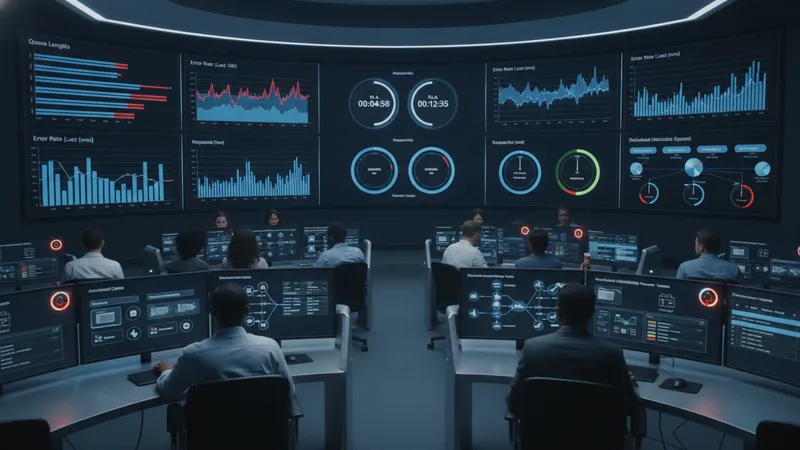
Reporting and analytics generally support both operational and historical analysis. Real-time dashboards may show active workloads and SLA compliance, while historical reports analyse throughput trends and process bottlenecks. Data export capabilities enable further analysis in specialised business intelligence tools. Administrators commonly define standard reports and automated distributions for stakeholders, ensuring visibility without manual report assembly each period. Report designs often include groupings by team, process stage, and time window to highlight recurring issues.
Notification and alert systems may use email, in-app messages, or integrations with collaboration platforms to communicate status changes. Notifications can be event-driven for immediate tasks or scheduled for daily summaries. Practical advice includes structuring alerts to minimise noise—grouping related issues and suppressing transient conditions—so operational staff can prioritise response. Retention of alert histories and post-incident reviews may support continuous improvement of thresholds and escalation paths.
Operational scaling considerations include load testing, horizontal scaling of stateless components, and capacity planning for databases and message brokers. Administrators often adopt staged rollout practices for configuration changes and extensions, and maintain rollback plans. Periodic reviews of resource usage and process patterns may reveal opportunities to refactor high-volume workflows into more efficient designs or to introduce batching where appropriate, keeping performance predictable as transaction volumes grow.