
Small business profit-and-loss management commonly relies on software designed to record and summarize revenues and expenses over a chosen reporting period. These tools typically collect sales receipts, invoices, bills, and expense entries, then map those transactions into categories that reflect operating income, cost of goods sold, operating expenses, and non-operating items. The result is a formatted statement that presents gross margin and net results for a period, often alongside underlying transaction lists and timestamps to support review and reconciliation.
Such software may include modules for categorization, basic bookkeeping rules, and reporting templates that align with common accounting presentation. It can support cash-basis or accrual-basis recording, allow for manual adjustments, and often provides exportable data for external accounting workflows. Small firms may choose different approaches depending on volume, staff skill, regulatory needs, and the level of automation they require; the software’s design influences how easily owners and advisors can interpret short-term profitability and expense structure.

Comparing these examples, spreadsheet-based methods typically provide maximum visibility into formulas and manual control but can become time-consuming as transactions increase. Cloud bookkeeping platforms often automate bank reconciliation and categorization, which may reduce time spent on routine entries while introducing dependency on mapping rules. Hybrid approaches can balance automation with oversight by keeping scanned receipts and exportable data for independent review. Each method may influence the frequency of reconciliations and the effort needed to produce a clear period statement that accurately reflects gross and net results for decision-making.
Transaction categorization is central to producing a useful statement. A practical chart of accounts groups revenue and expense types so that income streams and cost centers are visible at a glance. Categories may be nested to show high-level lines (e.g., sales, cost of goods sold, operating expenses) and detailed subcategories (e.g., supplies, subcontractors, utilities). Properly maintained categories can enable consistent month-to-month comparisons and support variance analyses, though they require disciplined entry practices and periodic cleanup when mappings drift or new transaction types appear.
Reporting and reconciliation workflows often determine how reliable the profit-and-loss results appear. Routine reconciliation of bank and payment-platform transactions against recorded sales and expenses can reduce classification errors and uncover timing mismatches. Software that stores transaction metadata and original receipts can help when cross-checking. Users should be aware that automated categorization rules may need adjustment and that audit trails and export options are useful for review by external advisors or for internal financial control processes.
Security, backups, and data export capabilities also affect ongoing usefulness. Systems that allow regular data exports in common formats and retain a history of edits typically support external review and migration if organizational needs change. Access controls that limit who can edit financial records and who can post adjustments may reduce accidental changes to prior periods. For small operations, a balance between automation and retained access to raw transaction data can aid transparency and preserve a clear record of how reported profit or loss was derived.
In summary, software choices and workflows shape how a small enterprise records revenues and expenses and arrives at its period profit or loss. Spreadsheet templates, cloud bookkeeping platforms, and hybrid toolsets each bring trade-offs in control, automation, and scalability. Consistent categorization, routine reconciliation, and clear exportable records typically improve the reliability of reported results. The next sections examine practical components and considerations in more detail.
Core feature sets for profit-and-loss tracking typically include transaction capture, categorization, reporting templates, and reconciliation tools. Transaction capture may occur through manual entries, uploaded CSV files, bank or payment processor feeds, or scanned receipts. Categorization often relies on a chart of accounts that maps transactions into revenue and expense groups. Reporting templates produce formatted period statements and may include customizable date ranges and comparative columns. Reconciliation tools compare recorded transactions to external statements and flag discrepancies. Recognizing these feature groups helps small firms decide which capabilities align with their recordkeeping needs.

Some systems add automated categorization using rules that map payee names or transaction descriptors to specific categories. These rules can reduce repetitive classification work but may require occasional review to correct false mappings. Reporting modules commonly allow subtotaling by category and exporting to spreadsheet formats for further analysis. Other features that can support profit-and-loss clarity include memo fields, tags for project or department tracking, and multi-period comparison views that reveal trends. Each feature typically reduces manual effort in different ways and may be more useful at particular transaction volumes.
Integration capabilities affect how complete the profit-and-loss picture can be. When accounting tools connect to invoicing systems, payroll platforms, point-of-sale terminals, or payment services, revenue and expense flows may be captured earlier and with greater detail. Integrations can also introduce synchronization concerns that require scheduled checks and occasional manual intervention. For small entities, choosing integrations that align with primary sales channels and major expense sources often increases coverage of income and outflow items without adding redundant data entry.
Security and data-retention features influence confidence in period results. Version history, user permissions, and export options allow owners and advisors to trace edits and retrieve source entries when investigating variances in reported profit or loss. Backup routines and readable export formats (CSV, XLSX) support external review and long-term recordkeeping. When assessing feature sets, organizations may weigh how each capability contributes to timely, auditable statements versus the administrative overhead required to maintain them.
Methods for entering revenue and expense data vary from fully manual entry to automated feeds and scanned-receipt workflows. Manual entry is straightforward for low transaction volumes but can increase the risk of data-entry errors as activity grows. Automated bank and payment feeds can populate transactions more quickly, though payee names and descriptions sometimes need human review to ensure proper categorization. Receipt scanning with optical character recognition (OCR) may capture amounts and dates but often requires verification, particularly for vendor names and tax-related fields. Combining methods can balance speed with oversight.
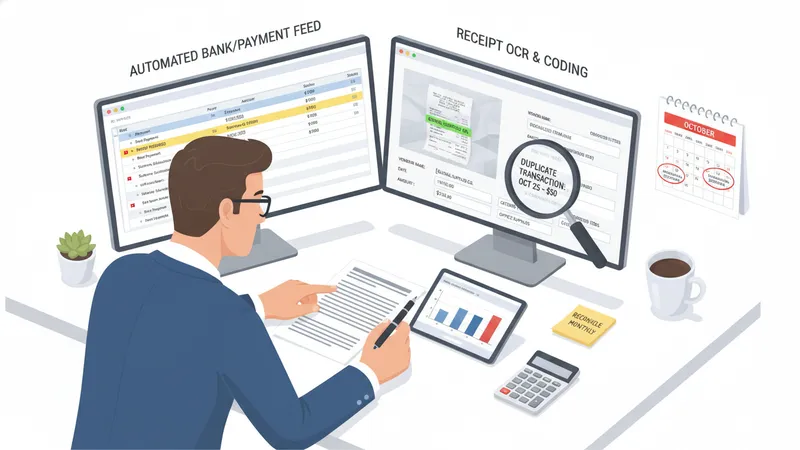
Reconciliation practices are central to accuracy. Regularly comparing the software’s transaction list to external statements—bank, merchant, or payment processor—helps identify missing items, duplicate entries, or misclassified transactions. Reconciliation workflows may include clearing entries, marking matched transactions, and recording adjustments for bank fees or timing differences. Establishing a cadence for reconciliation, such as monthly or quarterly, typically reduces the accumulation of unresolved discrepancies that can distort profit-or-loss reports.
Maintaining a clear audit trail supports confidence in reported results. Systems that log who created or edited entries, with timestamps and notes, make it easier to trace changes and understand prior-period adjustments. When corrections are necessary, keeping notes and preserving original entries rather than overwriting history can aid later review. For small businesses that engage external advisors periodically, readable audit trails and exported transaction lists simplify third-party reviews without requiring re-entry of historical data.
Common accuracy challenges include inconsistent categorization, uncaptured petty transactions, and timing differences between cash receipts and recorded revenue under accrual accounting. Addressing these challenges often involves standardizing category mappings, capturing small expenses through regular batching or expense policies, and clarifying the chosen basis (cash versus accrual) for reporting. Such practices may reduce ambiguity in period results and support clearer interpretation of operating performance.
Profit-and-loss reporting is frequently used alongside budgeting and cash-flow visibility features to monitor short-term financial health. Budget modules allow entities to set expected revenue and expense amounts for future periods and compare actuals to plan. Variance reporting can show which categories deviate from expectations and by how much, which may aid internal planning and operational adjustments. Cash-flow views that project inflows and outflows based on open invoices, scheduled bills, and typical timing patterns can help users anticipate liquidity constraints and prioritize transactions.
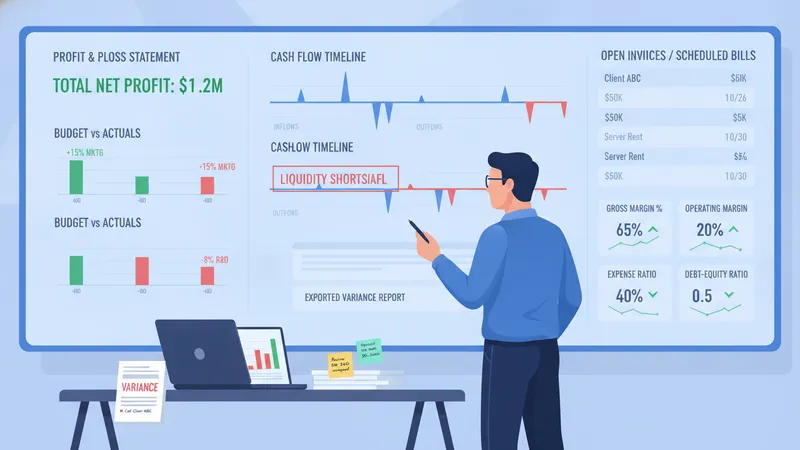
Key performance indicators linked to profit-and-loss items—gross margin percentage, operating margin, or expense ratios by category—may be available within software dashboards or through exported reports. Monitoring these KPIs over rolling periods can highlight structural shifts in expense composition or revenue mix. When setting KPIs, users often choose measures that reflect their business model, such as gross margin for product sellers or utilization rates for service providers, and track trends rather than isolated values.
Forecasting features that use historical profit-and-loss data to project future results typically rely on assumptions about sales pace, seasonal patterns, and recurring expenses. Forecasts may be presented at monthly, quarterly, or annual intervals and can be scenario-based to reflect optimistic or conservative assumptions. While forecasts may aid planning, their accuracy depends on the quality of underlying data and the reasonableness of assumptions; periodic revision is a common practice to keep projections aligned with actual performance.
Routine performance monitoring benefits from combining summary statements with transaction-level access so users can drill into specific variances. For example, a rising marketing expense line item may be reviewed by filtering transactions tagged by campaign or vendor. Maintaining tags, project codes, or customer identifiers within transactions can support this level of analysis and make profit-and-loss insights more actionable for operational decision processes.
Initial setup typically involves defining a chart of accounts and mapping existing transaction categories into the system. A clear chart of accounts tailored to the organization’s operations may make period profit-and-loss statements more interpretable. During implementation, importing historical transactions and reconciling opening balances may be necessary to ensure continuity in reporting. Organizations often document mapping rules and category definitions to maintain consistency as staff change or as new transaction types emerge.
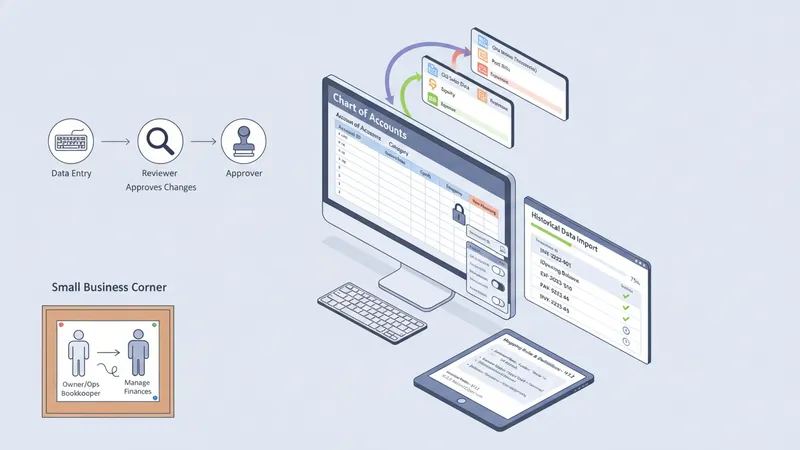
User roles and permissions can limit who may edit financial entries or post period adjustments, providing internal control over reported results. Assigning roles for data entry, review, and approval creates separation of duties that may reduce accidental errors. Small operations may apply simpler role structures but should still document who is responsible for reconciliation and who has authority to make adjustments to prior periods to preserve accountability.
Maintenance tasks include periodic review of category mappings, cleanup of uncategorized transactions, and reconciliation of bank and payment-platform statements. Updating automated rules and integrations when vendor descriptors change helps keep categorization accurate. Regular exports and archived backups in common file formats support data portability and review by external advisors, which can be useful for tax preparation or financial audits where source data must be examined.
Training and documentation contribute to sustainable practices. Simple guides describing category definitions, the reconciliation cadence, and how to handle exceptional items can reduce variability in recordkeeping. Periodic reviews of reporting needs and the software’s configuration may help ensure that the profit-and-loss outputs continue to reflect the organization’s informational needs as it grows or changes. This ongoing attention tends to preserve accuracy and usefulness of periodic statements over time.