
An inventory management system coordinates how a business records, stores, moves, and values its physical stock. Such systems combine procedures, data models, and software tools to track quantities, locations, and status from purchase through sale or disposal. They typically cover receiving, putaway, picking, transfers, cycle counting, and stock adjustments. The objective is to provide a reliable, auditable record of inventory so organizations can align supply with demand, maintain working capital control, and support operational workflows across purchasing, sales, and warehousing.
These systems may use different control methods and workflows depending on product mix, transaction volume, and organizational priorities. Core functions often include real-time stock ledgers or periodic reconciliations, reorder triggers, valuation routines, and interfaces to barcode or RFID hardware. Reporting and analytics components commonly provide visibility into turnover, aging, and item-level performance. Implementation design usually maps to existing operational tasks so that day-to-day staff can complete receiving, counting, and fulfillment with consistent procedures.

Perpetual recording typically reduces the need for full physical counts by keeping the ledger aligned with transactions, though periodic audits often remain necessary. This approach may be more suitable where transaction volumes are moderate to high and where automated scans or system integrations exist. Perpetual control can support more frequent replenishment decisions and can make valuation entries simpler because movements are recorded as they occur; however, it usually requires disciplined operational scanning and procedures to maintain accuracy.
ABC classification helps prioritize resources by recognizing that a small subset of SKUs often accounts for a large share of value or usage. Items labeled as category A may receive tighter counting schedules and stricter approval for adjustments, while B and C items may have progressively relaxed controls. When paired with other techniques—such as cycle counting frequency tied to ABC tiers—classification can reduce counting workload while preserving control over critical inventory.
Warehouse Management System modules typically include directed putaway to place incoming stock in optimal locations, pick routing to reduce travel time, and task batching to group similar work. WMS functionality can be implemented in standalone systems or as part of broader enterprise suites. Adoption often depends on warehouse complexity: single-location operations may use simpler location records and bin management, while multi-zone, high-throughput facilities may use WMS features to coordinate labor and equipment effectively.
Reordering and stock control logic usually combines lead time estimates, safety stock rules, and demand forecasts. Reorder points may be calculated using historical usage and supplier lead-time variability, and safety stock can be set to buffer forecast uncertainty. These parameters may be adjusted periodically based on observed service levels or seasonality. Sophisticated systems may enable dynamic reorder suggestions that account for promotions, planned outages, or upcoming demand spikes, but such features often rely on quality input data to be useful.
Inventory valuation methods—such as first-in, first-out (FIFO), weighted average cost, or specific identification—affect financial reporting and cost of goods sold. Choice of valuation method can influence reported margins and tax calculations where applicable. Systems generally maintain cost layers or running averages to support the selected accounting method, and they often provide audit trails for cost adjustments. Integration between operational movements and accounting entries is typically required to ensure consistent valuation across records.
In summary, a practical inventory control approach combines transaction recording, classification, warehouse processes, and valuation rules to support operational accuracy and financial integrity. Each component may vary in complexity depending on transaction volumes, product characteristics, and organizational tolerance for risk. The next sections examine practical components and considerations in more detail.
Stock tracking covers how movements are captured and how counts are validated. Systems may rely on manual entry, barcode scanning, or RFID reads to capture receipts, transfers, and shipments. Barcode scanning is commonly used to reduce transcription errors and to speed receiving and picking steps; RFID can enable bulk reads and faster cycle counts where hardware and tag costs are justified. Regardless of capture method, consistent procedures for identifying items, quantities, and locations typically improve data quality and traceability.

Counting strategies vary from periodic full physical inventories to continuous cycle counting. Cycle counting schedules often tie counting frequency to item importance or turnover, so higher-value or fast-moving items are counted more frequently. Cycle counts may be designed to occur without disrupting operations, using short, targeted tasks that reconcile ledger vs. physical counts. Wherever possible, counting procedures may include documented variance investigation workflows and corrective actions to prevent recurring discrepancies.
Location management is a complementary element: precise bin, shelf, or zone records make counts and putaway more efficient. Systems that maintain unique identifiers for storage locations can support directed tasks and reduce search time during picking. Location accuracy may be monitored through reconciliation reports that flag inactive or misused locations, and routine housekeeping procedures often reduce location-related errors by ensuring stock rests where the system expects it.
Data quality controls, such as barcode label validation, dual-count verification for critical items, and time-window constraints on transaction edits, can reduce the incidence of mismatches between physical stock and the ledger. Organizations may implement exception reporting that highlights negative stock balances, duplicate serial numbers, or unusually large adjustments. These controls typically function best when paired with clear operational responsibilities and review practices that assign accountability for corrections.
Purchase and receiving workflows link procurement activity to inventory records. Typical systems record purchase orders, expected arrival dates, and planned quantities so that receipts can be matched to orders and invoices. Matching procedures—three-way match between purchase order, receipt, and supplier invoice—are common controls to verify that inventory costs are recorded only for goods actually received. Receiving workflows often include inspection steps to capture damaged or nonconforming items and to create appropriate adjustment or return records.

Lead time management and supplier variability are central to replenishment calculations. Systems may store supplier lead-time averages and variability measures to inform reorder points and safety stock. Where lead times are volatile, teams may opt for higher safety stock or more frequent review intervals. Supplier performance metrics, such as on-time delivery rates and fill rates, are often tracked in reporting modules to inform sourcing decisions and to highlight areas where expectations or processes may need alignment.
Goods receiving typically involves physical checks for quantity and condition, barcode or RFID tagging where required, and immediate system updates to reflect available stock. Putaway logic then assigns storage locations based on item attributes, turnover, and available space. For serialized or batch-controlled items, receiving workflows usually capture unique identifiers and expiration dates to support traceability and compliance requirements, especially for regulated goods.
Integration points between procurement, receiving, and finance are commonly required so that inventory movements trigger appropriate accounting entries. Systems may support staged receipt statuses—such as received-but-not-inspected or received-and-accepted—to prevent immediate cost recognition until quality checks are complete. Clear rules about when costs and liabilities are recorded typically improve the alignment of operational records with accounting requirements.
Order fulfillment workflows convert sales orders into picking, packing, and shipment tasks. System features that support fulfillment include pick list generation, batch picking, and wave planning for larger operations. Routing logic may prioritize older stock (for perishable items) or optimize pick paths to reduce labor. Packing and shipment steps usually record what leaves the facility and update inventory ledgers accordingly, and systems often capture carrier and tracking details to maintain audit trails.

Warehouse layout and slotting strategies can affect throughput and picking efficiency. Slotting assigns items to locations that reflect demand patterns, reducing travel time for high-turn SKUs and grouping complementary items for multi-line orders. Slotting analyses often consider item dimensions, weight, and handling requirements. Reconfiguration of slotting may be scheduled periodically based on turnover changes or seasonal shifts and is usually driven by data from inventory reports.
Reordering controls combine demand signals, lead-time expectations, and safety stock settings to generate replenishment suggestions or automated orders. Reorder techniques may be simple fixed reorder points, economic order quantity calculations, or forecast-driven replenishment using time-series projections. Systems commonly allow rules by SKU or location so that unique constraints—such as minimum order quantities or vendor pack sizes—are factored into suggested quantities.
Exception management is a necessary part of fulfillment and replenishment. Examples include split shipments when stock is insufficient, backorder tracking for pending fulfillment, and purchase order amendments when forecasts change. Visible exception reporting helps operations respond to stockouts or overstocks and allows planners to adjust safety stock parameters or supplier agreements. These corrective processes typically depend on accurate baseline data from receiving, counting, and sales channels.
Integration between inventory systems and other business systems—such as accounting, point-of-sale, e-commerce platforms, or enterprise resource planning suites—helps maintain consistent records across functions. Common integration patterns include API-based transaction feeds, file-based batch updates, or direct database synchronization. Integration design often considers transaction latency, reconciliation points, and error handling so that downstream systems receive timely, accurate inventory and cost information.
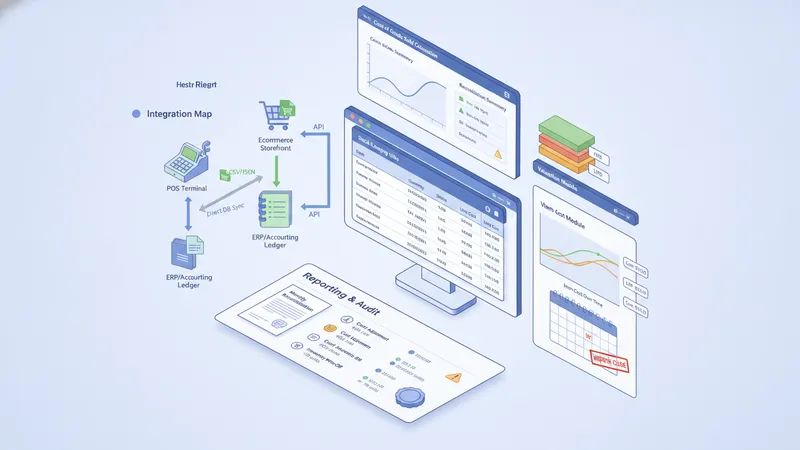
Valuation methods implemented in the system must align with accounting policies or regulatory requirements. Systems may maintain cost layers for FIFO, compute moving averages for weighted cost, or hold item-level costs for specific identification. Valuation impacts financial statements and cost of goods sold calculations, so transparent audit trails for cost adjustments and inventory write-offs are typically important. Reporting modules often provide reconciliation reports to support month-end close activities.
Reporting and analytics provide operational visibility through metrics such as inventory turnover, days of supply, stock aging, and fill rate. Dashboards and scheduled reports may highlight slow-moving items or excess stock that ties up working capital. Analytics can also support scenario planning for promotions or supplier disruptions, although the usefulness of scenarios typically depends on the underlying data quality and forecast assumptions used.
When evaluating system capabilities, organizations often consider scalability, ease of integration, and the clarity of role-based workflows to support operational adoption. Internal considerations may include staff training needs, physical infrastructure such as scanners or labels, and policies for handling discrepancies. These practical elements typically determine how effectively an inventory approach translates into consistent operational performance over time.