
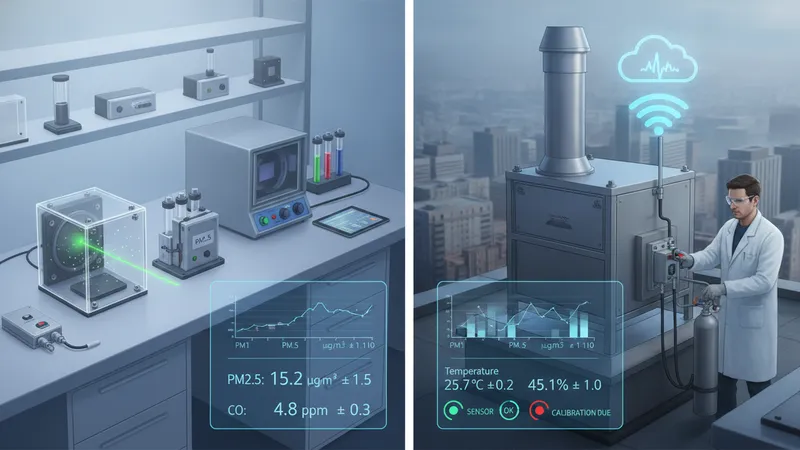
Air quality monitoring relies on instruments that quantify airborne particles and reactive gases. These instruments range from compact sensor modules to reference-grade samplers. Particle-detection components typically measure size-resolved concentrations by sensing light scattered by individual or aggregated particles, or by collecting particles onto filters for mass measurement. Gas-detection components may detect target molecules through chemical reactions, optical absorption, or ionization. Together, these systems translate physical or chemical interactions into electrical signals that represent pollutant concentrations over time. Data outputs often include time-stamped values, size fractions for particles, and indications of sensor status or uncertainty.
Routine monitoring systems integrate sensing elements with data acquisition, local processing, and networked transmission. Many monitors provide near real-time readings, while others operate on scheduled collection cycles for laboratory analysis. Calibration and quality assurance are commonly required to relate sensor signals to standard concentration units and to correct for environmental effects such as temperature and humidity. Applications span indoor air quality assessments, urban ambient networks, industrial emissions screening, and research studies that track temporal trends and source contributions without implying regulatory compliance by a single device.
Optical particle sensors and gravimetric samplers represent different trade-offs. Optical sensors can provide high temporal resolution and lower operational cost but may be influenced by particle composition, humidity, and coincidence errors at high concentrations. Gravimetric methods provide direct mass measurements and support chemical speciation but require laboratory processing and time. When both approaches are used together, optical data often serves as a continuous proxy that may be calibrated against periodic gravimetric results to improve long-term accuracy and comparability across sites.
Gas detection technologies vary by principle and target compound. Electrochemical cells can exhibit cross-sensitivity where one gas produces a signal similar to another; metal-oxide sensors may change baseline with temperature and require conditioning. Optical methods such as nondispersive infrared (NDIR) or ultraviolet absorption are often applied to stable gases like carbon dioxide or ozone and may offer greater selectivity. Photoionization detectors (PIDs) can measure a broad set of volatile organic compounds but typically report in terms of total ionizable compounds rather than species-specific concentrations.
Data collection and processing choices influence how pollution trends are interpreted. Short-term spikes detected by a sensor may reflect transient sources such as combustion events, while longer-term averages can indicate background levels. Typical monitoring systems include onboard filtering, averaging, or flagging routines to identify outliers and sensor drift. Metadata that records calibration dates, environmental conditions, and sensor diagnostics may improve post-processing and comparability across instruments. Analysts often apply uncertainty estimates rather than single-value declarations to convey confidence in reported concentrations.
Common limitations of low-cost and compact monitors include sensitivity to environmental factors, sensor aging, and limited chemical selectivity. Many networks use reference-grade samplers at key sites to anchor broader sensor networks. Integrating multiple sensor types—particle counters with gas sensors and meteorological instruments—can aid source attribution by correlating pollutant patterns with wind, temperature, or human activity cycles. Such multi-parameter approaches typically increase interpretability while requiring careful data harmonization.
In summary, monitoring ambient and indoor pollutants relies on a combination of particle and gas sensing methods that trade temporal resolution, selectivity, and operational complexity. Optical particle counters, gravimetric samplers, and electrochemical gas sensors illustrate common approaches; each may be used alone or together depending on monitoring goals. Calibration, environmental corrections, and metadata practices often determine the usability of measurements for assessment or research. The next sections examine practical components and considerations in more detail.
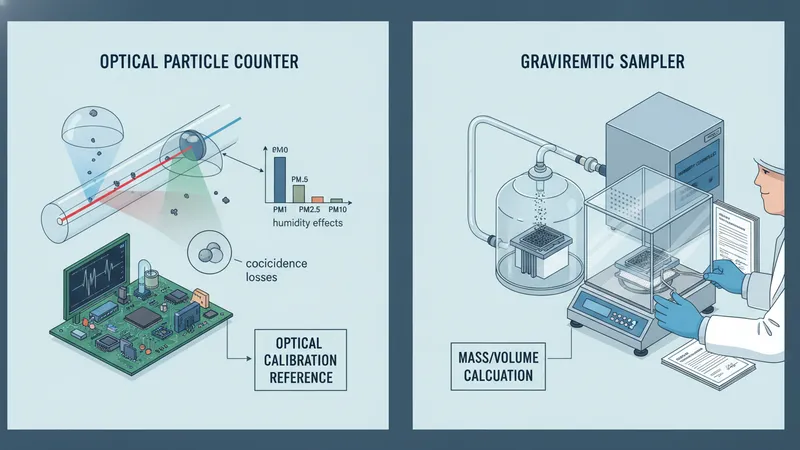
Optical particle counters use light scattering to detect individual particles and classify them by size bins. Their electronics count pulses corresponding to scattering events and estimate mass concentrations through conversion factors that assume particle density and shape. These instruments typically report size-resolved number concentrations and derived mass for PM1, PM2.5, and PM10 fractions. Considerations include coincidence losses when particle concentrations are high, interference from high relative humidity that alters scattering, and the need for periodic calibration against gravimetric filters to adjust sizing and mass-conversion coefficients for local aerosol composition.
Gravimetric samplers collect particles on pre-weighed filters using controlled flow. After sampling, filters are conditioned and weighed in a laboratory balance to determine mass per unit air volume. This direct mass approach is widely used as a reference measurement because it does not rely on optical assumptions; however, it requires careful handling, controlled humidity during conditioning, and staff time. Gravimetric results often serve as calibration anchors or verification points for continuous optical sensors in monitoring programs where traceable mass measurements are important.
Optical instruments may be supplemented by condensation particle counters (CPCs) when ultrafine particle number concentrations are of interest. CPCs grow small particles using a working fluid and then count them optically, providing high sensitivity to submicron particles that may be missed by size-limited counters. While CPCs offer valuable information about number concentrations and nucleation events, they can be bulkier and require maintenance. Combining CPC outputs with mass-based measurements can help characterize particle size distributions and infer likely sources.
When selecting particulate monitoring approaches for a study or network, factors to weigh include temporal resolution needs, required size fractions, resource availability for laboratory analysis, and environmental conditions at the site. Field programs often pair continuous optical monitors with periodic gravimetric sampling and meteorological observations. Such hybrid designs allow continuous trend detection while retaining periodic reference-quality checks to account for environmental influences and sensor drift. These choices may vary with the monitoring objectives rather than being universally prescriptive.
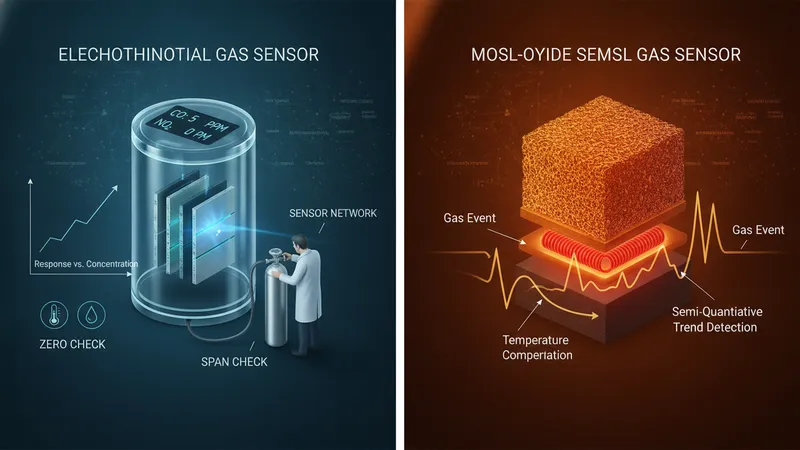
Electrochemical sensors operate by generating an electrical current when a target gas reacts at an electrode; the signal is proportional to concentration within a working range. These sensors are compact and commonly used for gases such as carbon monoxide (CO) and nitrogen dioxide (NO2). Performance is sensitive to temperature, humidity, and cross-sensitivity to interfering gases; periodic calibration against known gas concentrations is often necessary to maintain quantitative accuracy. In network deployments, routine zero and span checks can help identify drift and maintain data quality over time.
Metal-oxide-semiconductor (MOS) sensors detect gases by changes in surface conductivity when gas molecules interact with a heated sensing layer. MOS devices are durable and inexpensive but typically provide semi-quantitative responses that vary with temperature and baseline condition. They can be informative for detecting relative changes or event detection rather than precise absolute concentrations. Careful baseline characterization and temperature compensation strategies can improve MOS utility for trend detection and screening applications.
Optical gas sensing methods such as nondispersive infrared (NDIR) and ultraviolet (UV) absorption provide selectivity for particular molecular bonds and are often used for gases like carbon dioxide (CO2), carbon monoxide, and ozone. These instruments may be larger and more power-intensive but can deliver stable responses with lower cross-sensitivity than some electrochemical types. Photoionization detectors (PIDs) can detect a wide range of volatile organic compounds but typically report a summed response, so they are most useful where total volatile load rather than species-specific concentration is the target.
Choosing gas sensor technologies depends on monitoring goals and ambient conditions. For long-term trend analysis, instruments with stable baselines and documented calibration procedures are typically preferred; for portable screening, compact electrochemical or MOS sensors may be acceptable to identify areas for further study. Combining sensor types and including meteorological data can improve source attribution. These are considerations rather than prescriptive rules, and selection should match the intended measurement quality and logistical constraints.
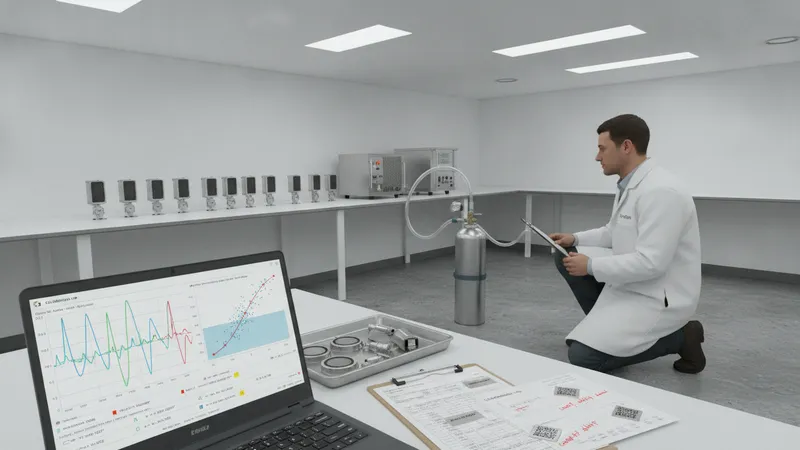
Data from particle and gas sensors often require preprocessing to be informative. Common steps include time-alignment of streams, averaging to appropriate time intervals, and removal or flagging of periods with sensor faults. Calibration transforms raw sensor outputs into concentration units; methods range from laboratory gas challenges and filter comparisons to field co-location with reference monitors and statistical correction models. Calibration frequency may vary by sensor type and environmental stressors, and calibration coefficients can drift with sensor aging. Documented calibration logs and metadata improve traceability and post-processing reliability.
Uncertainty characterization is a critical aspect of quality assurance. Reporting a concentration together with an uncertainty range or a quality flag helps data users interpret measurements appropriately. Uncertainty sources include instrument precision, calibration error, environmental interferences, and sampling artifacts. In practice, networks often implement routine intercomparisons, replicate sampling at select sites, and controlled checks to estimate combined uncertainties. These practices can clarify the expected reliability of trends and specific measurements without implying absolute certainty.
Data interoperability and standardization improve the value of monitoring networks. Using common time stamps, units, and data formats facilitates aggregation and comparison across instruments and sites. Open data protocols and metadata standards used by many research and monitoring communities can support integration with modeling, health studies, and regulatory assessments. While standards do not remove all comparability challenges, they often reduce barriers to multi-source analyses and enable more robust interpretations when combined with documented limitations.
Insider considerations include planning for sensor maintenance cycles, understanding power and communications constraints for remote sites, and preparing for seasonal changes that may affect sensor response. Deployments often budget time for initial co-locations with reference instruments and periodic checks thereafter. Analysts commonly apply conservative filtering rules during data cleaning and supplement quantitative outputs with diagnostic indicators that signal potential sensor degradation. These practices aim to preserve data usefulness while acknowledging typical operational limitations.
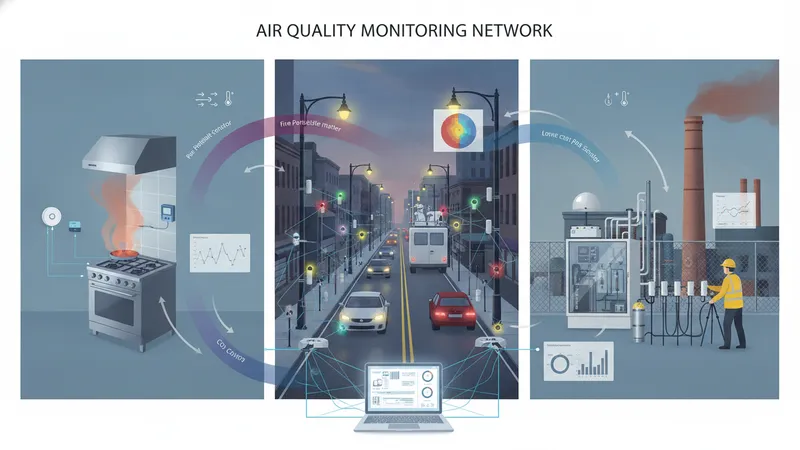
Monitoring systems are applied across indoor air quality assessments, urban ambient monitoring, industrial fence-line surveillance, and episodic event studies. Particle sensors can reveal diurnal patterns related to traffic, cooking, or heating, while gas sensors can identify combustion signatures, industrial releases, or ventilation issues. Integration of particle and gas data with meteorological variables enhances the ability to infer transport and likely sources. Applications differ in their required measurement fidelity; some use continuous, networked sensors to observe patterns, while others focus on periodic reference sampling for compliance or research rigor.
Limitations include sensor-specific interferences, environmental sensitivities, and the representativeness of point measurements for broader areas. Low-cost sensors often provide useful relative information but typically require calibration or comparison to reference methods for absolute quantification. Spatial variability in urban environments means that a single monitor may not capture neighborhood-level differences; dense sensor arrays or mobile monitoring campaigns can help map variability but require increased data management and calibration efforts to maintain comparability.
Integration strategies commonly combine continuous sensors for temporal resolution with periodic laboratory analyses for chemical speciation and mass-based reference points. Source apportionment methods, receptor models, and back-trajectory analyses can use combined datasets to suggest likely pollutant origins, though such analyses typically carry uncertainties and rely on complementary information. Cross-disciplinary collaboration among technicians, data scientists, and subject-matter experts can improve interpretation by aligning measurement design with analytic methods.
Overall, monitoring programs typically balance instrument selection, calibration rigor, and data-processing workflows to match objectives. Recognizing limitations, documenting methods, and applying conservative uncertainty estimates often strengthen the credibility of findings. Future sections could address emerging sensor developments and evolving best practices, but the present overview focuses on established measurement principles and practical considerations for particulate and gas monitoring.