
Straddle stackers are warehouse material-handling machines designed to lift and move palletized loads while straddling the pallet or load base. They typically consist of a frame with legs that pass on either side of a pallet, forks or a platform to support loads, and a mast with a lifting mechanism. Models range from manually operated hand-pump units to electrically powered machines with hydraulic or electric mast drives. These machines may be used where access is limited, where racking requires low clearances, or where load stability during lifting is a primary concern.
Their core functionality includes lifting loads to intermediate heights for stacking, transporting loads across short distances inside facilities, and positioning pallets for storage or retrieval. Control interfaces vary: manual units use physical levers and push/pull effort, while powered units often provide electronic controls, variable speed travel, and lift/lower actuation. Typical performance characteristics to consider are rated load capacity, lifting height, footprint width, and turning radius. Operation is usually confined to level, indoor surfaces and may require operator familiarity with pallet sizes and floor conditions.
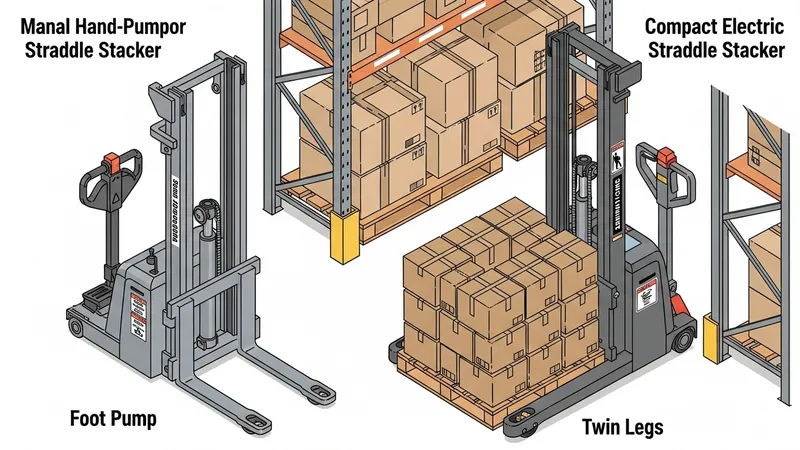
Design and chassis features often determine how a straddle stacker fits into facility workflows. Leg span and fork length dictate the pallet types that can be accommodated, while overall width affects aisle compatibility. Some units have adjustable legs or removable extensions to handle non-standard pallets. The mast design—single, duplex, or triplex—affects the maximum lift height and the collapsed height for maneuvering under obstacles. Frame materials and joint design may influence durability and service intervals; heavier-duty construction can increase service life in intensive use settings.
Lifting mechanisms vary and typically influence speed, capacity, and maintenance needs. Manual units usually rely on a hydraulic pump actuated by hand, which limits lift speed and operator endurance. Electric units can use hydraulic or chain-and-roller systems driven by electric motors; these can offer smoother, faster lifting and integrated brake systems. Rated capacities commonly range from a few hundred kilograms to over a ton, depending on the design. Load center, attachment geometry, and stability calculations often determine the actual safe working load under given conditions.
Maneuverability and controls are practical considerations in selection and operation. Steering systems may be centered on a tiller arm for pedestrian operation or include seated operator stations for larger powered units. Drive configurations influence turning radius and handling on different floor types; electric drives may include regenerative braking or speed control features. Visibility to the forks and load is important for safe placement; some masts are designed with open profiles or transparent sections to improve sightlines. Floor conditions, including slope and surface irregularities, often limit operational areas.
Maintenance and inspection practices typically affect uptime and long-term operating cost. Regular checks often include hydraulic fluid levels, battery condition for electric units, fork and mast wear, wheel condition, and the function of brakes and safety interlocks. Preventive maintenance schedules may follow manufacturer guidance and facility usage patterns, with heavier use requiring more frequent calibration or replacement of wear items. Operator training on routine inspections can help identify issues early; such inspections may be brief but can reduce the likelihood of mechanical faults during operation.
In summary, straddle stackers combine a narrow operational footprint with the capacity to lift and position palletized goods where full-size forklifts may be impractical. Variations in drive system, mast configuration, and chassis dimensions typically influence suitability for particular tasks and environments. Selection often balances lifting height, load capacity, maneuverability, and maintenance expectations. The next sections examine practical components and considerations in more detail.
Different configurations of straddle stackers address varied operational needs. Common distinctions include manual versus powered drives, the number of mast stages (single, duplex, triplex), and leg or fork adjustability. Manual jack-style stackers may be suitable for intermittent, low-height use and often present lower capital complexity. Electric models can provide higher lift speeds and reduced operator effort, which may be relevant for repetitive tasks. Adjustable-leg designs can accommodate irregular pallets or caged loads. Understanding these configurations helps align a unit’s capabilities with facility constraints such as aisle width and pallet dimensions.
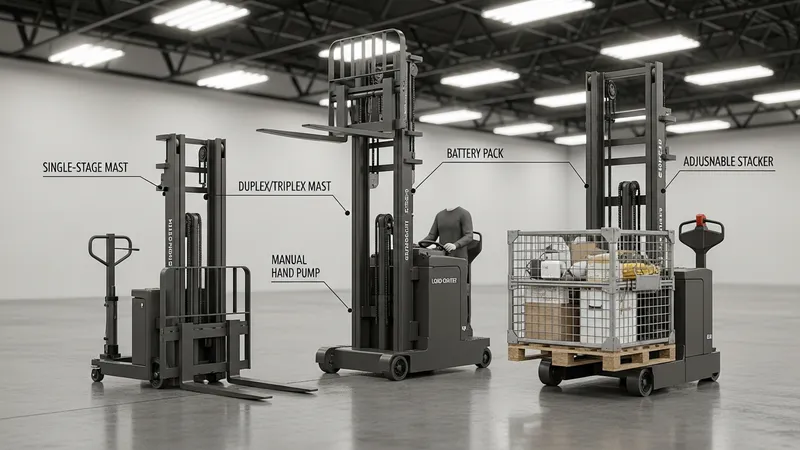
Chassis and fork geometry also affect compatibility with common pallet types and load profiles. Fork length and spacing must match pallet base dimensions to avoid instability. Some units offer removable or telescoping forks to handle non-standard pallets or crates. The straddle legs may be fixed or foldable; foldable legs can facilitate storage or transition through narrow doorways, while fixed legs tend to be mechanically simpler. Manufacturers may provide specification sheets that list recommended pallet sizes and load centers for each model, which can inform planning without prescriptive advice.
Drive and steering arrangements vary and can influence operator ergonomics and control precision. Tiller-steered pedestrian units often provide compact control for walking operators, while ride-on or platform variants may be used when longer travel distances are required. Electric drives commonly provide variable speed control and may include integrated safety features such as dead-man switches or controlled deceleration. When considering configuration, it may be useful to map typical travel routes, floor conditions, and lift sequences to potential machine footprints and steering systems to identify likely fit.
Operational trade-offs appear across configurations: manual units can be simpler to maintain but slower to operate, while powered units can improve throughput at the cost of battery maintenance or electrical systems servicing. Mast stage count can allow higher stacking but may increase complexity and reduce rigidity. Facilities often balance these variables by matching duty cycles—frequency and duration of lifts—to the stacking equipment’s rated design. These considerations may guide specification and procurement discussions in an informational way rather than acting as prescriptive recommendations.
Lifting systems in straddle stackers commonly include hydraulic cylinders, chain-and-sprocket assemblies, or electric-actuated lifts. Hydraulic lifts may be manually pumped or energized by an electric motor. Chain-driven masts are frequently used for higher lifts where synchronized travel of mast stages is required. Rated load capacity is typically specified at a particular load center; shifts in the load center or adding attachments can reduce the effective capacity. Specifications often list a nominal capacity and the corresponding lift height at that rating, which can be used to compare potential suitability for tasks.
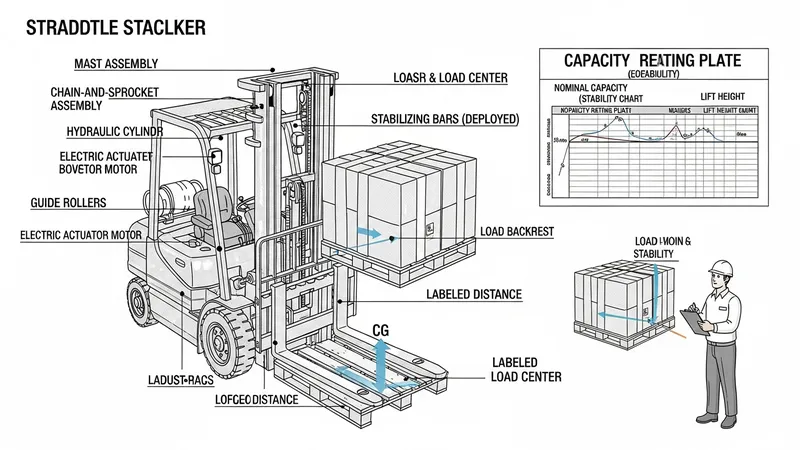
Load center and stability calculations often determine actual safe working loads under real conditions. The load center is the distance from the fork face to the center of gravity of the load and is a critical parameter in capacity tables. Moving bulky or top-heavy loads can reduce stability and should be accounted for in planning. Some straddle stackers include load backrests, wider fork spacing, or stabilizing bars to improve load support. These are design features that may influence handling characteristics rather than guarantees of performance.
Typical capacity ranges for warehouse straddle stackers may span from several hundred kilograms up to approximately one tonne or slightly more for heavier-duty models. Higher-capacity machines usually feature more robust frames, larger wheels, and stronger mast components, which can affect maneuverability and required floor load ratings. Lift speed and lowering speed are additional specifications that may be relevant for operational throughput; electric lifts often provide faster cycle times than manual pumps, with corresponding implications for duty cycles and battery or motor wear.
When assessing lifting systems, maintenance implications should be considered as part of informational planning. Hydraulic systems may require periodic fluid checks and seal inspections, while chains and rollers need lubrication and tension adjustment. Electric lifting motors and controllers often require attention to electrical connections and battery health. These maintenance patterns are factors that can affect long-term usability and are useful to consider alongside load capacity and lifting height in operational planning.
Built-in safety features commonly include mechanical or electronic overload protection, emergency stop controls, parking brakes, and fork-level indicators. Some powered models incorporate speed limiters, lift interlocks, and audible or visual alerts for travel or lifting actions. Regular inspection of wear items—wheels, bearings, fork heels, and mast rails—is often advised to identify potential safety concerns early. Safety systems may reduce the risk of incidents when properly maintained, and awareness of these features can inform operational risk assessments.
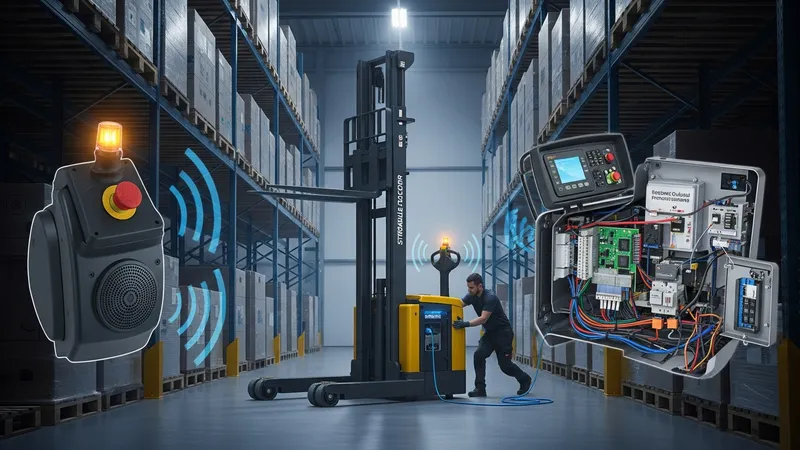
Maintenance considerations often encompass daily operator checks, scheduled preventive maintenance, and periodic component replacement. Battery-powered units require battery care routines such as correct charging practices and electrolyte inspections when applicable. Hydraulic systems may require fluid replacement intervals and seal inspections. Recording maintenance activities and tracking service intervals can help facilities plan downtime and parts procurement. These practices are shared information rather than directives and may vary by machine design and usage intensity.
Operator training and familiarization are relevant to safe operation but should be described as considerations rather than mandates. Familiarity with control locations, load handling characteristics, and shutdown procedures may reduce misuse that could lead to equipment stress or unsafe conditions. Facilities often pair equipment selection with documented operating procedures and routine checks to maintain predictable performance. Such procedural elements may also be useful when integrating straddle stackers into broader material-handling systems.
Environmental and floor conditions impact both safety and maintenance needs. Uneven floors, debris, or slopes can increase wear on wheels and motors and may affect stability during lifting. Ensuring travel pathways are kept clear and assessing floor load capacity where heavier units are used are informational factors to include in planning. Regular housekeeping and floor inspections may reduce mechanical stress on stackers and contribute to consistent operation over time.
Straddle stackers are often found in distribution centers, retail storerooms, light manufacturing, and shipping/receiving areas where pallet handling is common but space or throughput constraints make larger forklifts impractical. They may be used for loading and unloading from low docks, staging pallets for order picking, or stacking goods on low to medium-height racking. In facilities with narrow aisles or frequent short moves, compact footprint and maneuverability may be prioritized. Describing typical contexts helps clarify where such equipment may be applied without prescriptive recommendations.
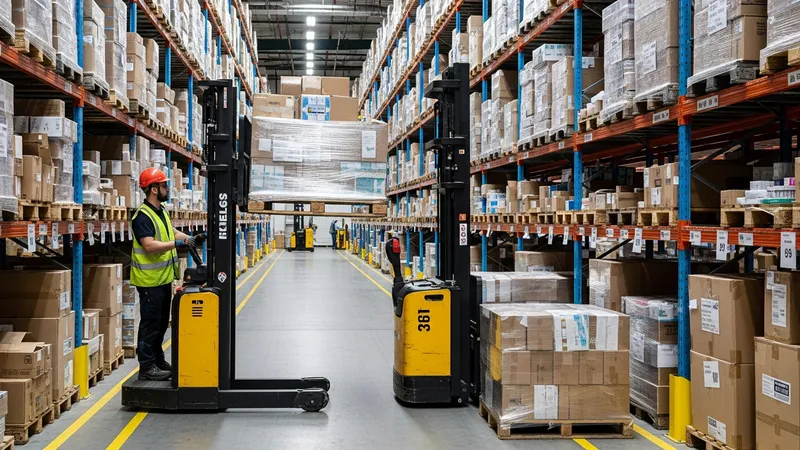
Integration into workflows often involves mapping pallet sizes, aisle widths, and lift sequences to unit specifications. For example, facilities that handle partial pallets or non-standard packaging may prefer adjustable forks or leg spacing. High-turnover staging areas might benefit from powered drives for reduced operator fatigue, while infrequent use areas may accept manual units. These are contextual trade-offs to consider when aligning equipment characteristics with expected task patterns and facility layouts.
Operational planning frequently includes consideration of supporting infrastructure such as battery charging areas, maintenance access, and storage for spare parts. Battery charging requires appropriate ventilation and space planning; charging schedules may affect shift patterns if powered units are used extensively. Maintenance bays or access to trained technicians can influence downtime expectations. These logistical elements are practical considerations that often accompany deployment decisions and may vary by facility and usage intensity.
Finally, lifecycle and total-use considerations may include resale value, parts availability, and ease of servicing. Common wear items—wheels, chains, hydraulic seals—can shape long-term maintenance costs and downtime patterns. Choosing models with readily available spare parts or established service support can simplify maintenance planning without implying endorsement. Readers may find it useful to compare specification sheets and maintenance schedules as part of informational planning when assessing how straddle stackers could fit into their operational environment.