
Industrial-scale equipment for blending elastomeric polymers with fillers, plasticizers, curatives, and other additives enables consistent compound preparation before shaping and curing. These machines vary by configuration and mixing action: some enclose rotating rotors inside a chamber to knead a batch, others use counter-rotating rolls on an open mill, and continuous lines combine shear and residence-time control. The principal objective of these systems is to distribute solid and liquid ingredients uniformly, control temperature and viscosity during processing, and deliver material in a form suitable for subsequent operations such as extrusion, calendering, or molding.
Design choices influence energy input, batch size, maintenance needs, and process repeatability. For example, enclosed batch mixers often allow tighter control of internal temperature and shorter residence times, while open mills permit visual inspection and manual adjustments during mixing. Continuous mixers may be used where steady throughput and narrow residence-time distribution are priorities. Selection typically involves trade-offs among material throughput, heat management, shear profile, and downstream compatibility, so understanding machine classes and operating parameters is essential for consistent compounding outcomes.
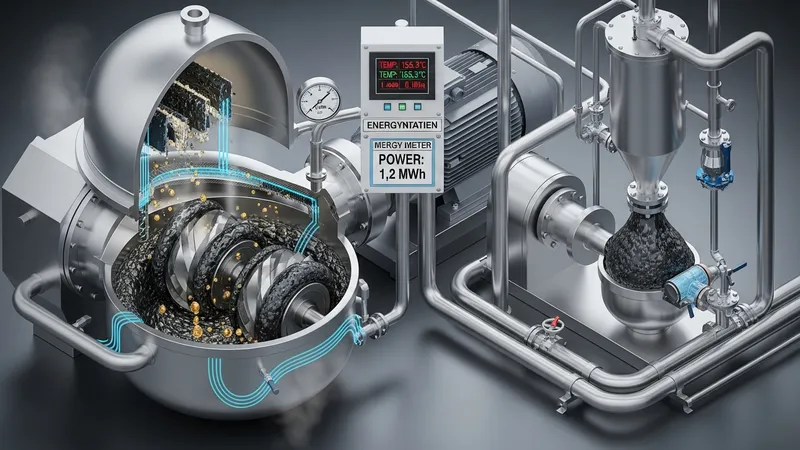
Comparing these machine types highlights typical trade-offs: enclosed batch mixers generally produce homogenous dispersion in smaller, controllable batches and may reduce operator exposure to airborne dust, while open mills can handle large sheets and facilitate visual inspection but may require more manual skill. Continuous mixers can improve throughput consistency and reduce per-unit handling, yet they often demand precise dosing and upstream feeding systems. Each configuration may be paired with different downstream handling equipment, and material formulation adjustments frequently accompany a change in mixing platform to maintain target compound properties.
Key process variables during mixing often include rotor speed, fill factor (volume occupied by compound versus chamber volume), cycle time, and specific energy input. Temperature control is critical because many additives activate or soften at elevated temperatures; systems may use water or oil cooling jackets, cooled rolls, and real-time sensing to maintain target ranges. Monitoring power draw and torque can indicate compound viscosity and dispersion progress: a rise or fall in power consumption may signal over- or under-mixing. These measurements typically inform process endpoints rather than absolute guarantees of performance.
Safety and maintenance aspects also shape equipment selection and layout. Enclosed mixers usually include interlocks, emergency stops, and specified lockout-tagout procedures to reduce entrapment risk, while open mills require barrier use and operator training to lower hazards associated with moving rolls. Scheduled maintenance of seals, rotor bearings, hydraulic systems, and drive components may extend service life and preserve mixing consistency. Maintenance planning often balances production continuity against the need for periodic shutdowns to inspect wear-sensitive parts.
Quality control in compounding typically involves sampling for dispersion tests, Mooney viscosity or cure rheometry, and dimensional checks after shaping. These analytical checks may be performed at set intervals or following process adjustments. Traceability of batch records, including ingredient lot numbers and mixer cycle parameters, can assist in root-cause analysis when deviations occur. The next sections examine practical components and considerations in more detail.
Batch internal mixers, open two-roll mills, and continuous mixers represent common families of rubber mixing equipment, each with distinct mechanical and thermal characteristics. Internal mixers use intermeshing rotors in a closed chamber to impart intensive shear; they may be equipped with ram systems to control fill and discharge. Two-roll mills rely on friction and folding actions between heated rolls to achieve dispersion, often used for small-scale or laboratory adjustments and for tack control before calendaring. Continuous mixers combine screw or rotor conveyance with controlled residence time, favoring steady production and integration with continuous downstream processes.
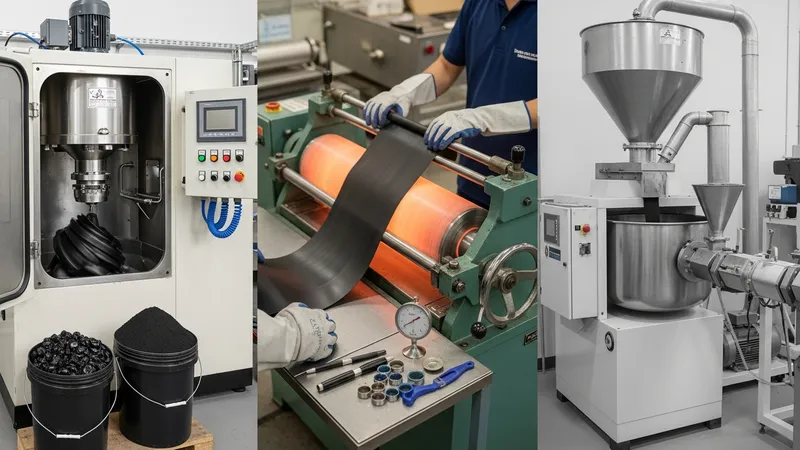
Typical considerations when choosing among these types include expected throughput, compound viscosity, heat sensitivity of additives, and the need for visual process intervention. For elastomers sensitive to temperature-induced reactions, enclosed mixers with robust cooling may help limit premature crosslinking. When formulations include large-volume fillers that require high mechanical energy to disperse, machines that can generate sufficient shear while avoiding excessive temperature rise are often selected. Cost, floor space, and operator skill also influence the practical choice of equipment.
Operationally, scaling a formulation between mixer types may require adjustments to fill factor, rotor speed, or blending sequence. For example, a compounding sequence developed on an open mill can often be translated to an internal mixer by altering the order and intensity of additions to achieve similar dispersion states. Continuous systems may demand reformulation to accommodate steady-state feeding and shear history. These translation considerations are non-prescriptive framing points that typically guide process development and laboratory-to-production scale-up.
Insider considerations often include the expected maintenance cadence for each machine type and the availability of replacement parts for wear-prone components such as rotor tips, roll covers, and seals. Noise, dust control, and local exhaust requirements can differ: enclosed mixers typically limit airborne particulate release, while open mills may require more extensive local ventilation. Factoring these operational elements into equipment selection may reduce downstream process interruptions and support more consistent compound characteristics over time.
Rotors are primary mechanical elements in enclosed mixers and are shaped to generate kneading, shearing, and folding actions. Rotor geometry, clearance, and rotational speed determine shear profile and dispersion capability. In open mills, the heated roll surfaces and nip setting control the mechanical energy imparted to the compound. Drive systems—electric motors, gearboxes, and hydraulic rams—provide force and motion; their responsiveness and control fidelity can influence cycle precision. Accurate torque and power measurement in drives often serve as process indicators rather than absolute metrics of compound quality.
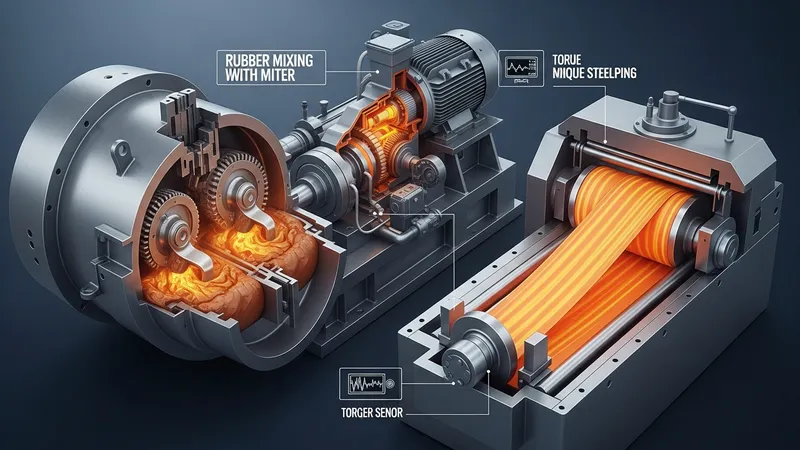
Temperature control components include heating elements, cooling jackets, and thermostatic regulation systems. For enclosed mixers, chamber walls and rotors may be water- or oil-cooled to absorb exothermic heat of mixing; rolls often have internal channels for heat transfer fluids. Sensors such as thermocouples or RTDs monitor internal temperatures and feed data to control systems. Seals and bearings allow rotating parts to operate while containing compound and lubricants; their condition often affects contamination risk and operational reliability, and wear monitoring may inform preventive maintenance schedules.
Material handling subsystems—feeders, weigh scales, and dosing valves—contribute to compound consistency by controlling additive sequence and mass fractions. Accurate dosing of fillers, curatives, and liquids often matters more than minor variations in mixer shear, because ingredient ratios strongly influence final properties. Discharge mechanisms and downstream transfer, such as ram ejection in internal mixers or feed screws on continuous lines, determine how the mixed compound is presented to subsequent processes. Controls and human-machine interfaces provide recipe management and capture cycle data for traceability.
Considerations for component selection include ease of access for inspection, modularity for parts replacement, and compatibility with existing plant utilities such as cooling water quality and electrical supply. Corrosion-resistant surfaces or specific coatings may be specified where abrasive fillers or reactive chemistries are used. Designers often balance robust construction against the need for precision control and easy servicing; these trade-offs typically reflect the intended production scale and expected compound complexity.
Mixing workflows often follow a defined sequence: pre-blending of powders, staged addition of fillers, incorporation of plasticizers and process aids, and final addition of curatives near discharge to limit premature reaction. Sequence and timing can influence dispersion and vulcanization behavior; for temperature-sensitive curatives, delayed addition or lower-temperature blending steps may be typical. Process engineers frequently document parametric windows—such as rotor speed ranges, fill ratios, and target chamber temperatures—to support repeatability across batches or shifts.
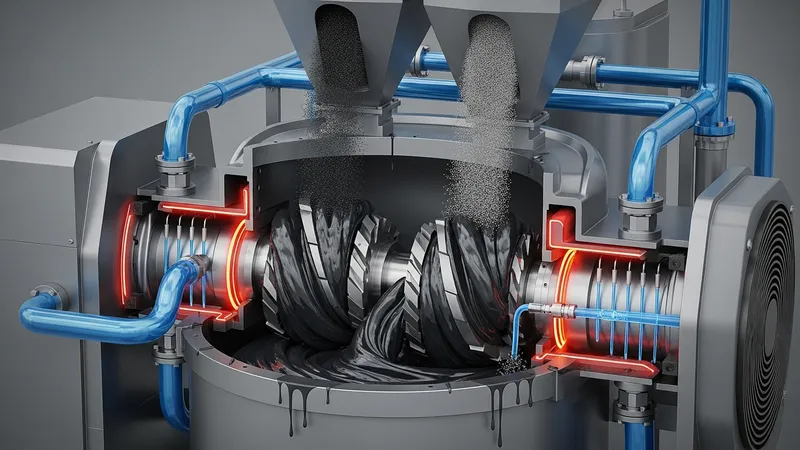
Energy input to the compound, sometimes described through specific energy or power/torque profiles, can indicate dispersion progression. Monitoring trends in motor current or torque may help identify when filler networks have broken down sufficiently, though these signals are process-relative rather than absolute. Temperature rise during mixing results from mechanical energy dissipation and exothermic reactions; managing heat removal through cooling passages or intermittent mixing sequences can limit undesired chemical activation and maintain workable viscosities.
Instrumentation and control strategies commonly include closed-loop temperature control, recipe-based sequencing, and data logging for cycle parameters. Laboratory tests such as dispersion index, particle size distribution of fillers, and rheometry (e.g., Mooney viscosity, cure curves) are used to correlate process settings with final compound behavior. These analytical techniques often guide adjustments in mixing time or rotor speed rather than serving as stand-alone directives, supporting iterative process optimization in a measured way.
Operational tips presented as considerations include staging high-energy dispersion steps early and introducing curatives near the end of mixing to reduce scorch risk, and considering lower fill factors when dispersing highly loaded formulations to improve movement and heat dissipation. Balancing shear and temperature often involves compromise: increasing shear improves filler wetting but may increase temperature; cooling capacity and real-time monitoring can help manage this trade-off during process development and routine operation.
Rubber compounding equipment is widely used across sectors such as automotive sealing and tire components, industrial belting and hoses, footwear midsoles and outsoles, and molded technical parts. Different applications demand varied compound properties—e.g., high abrasion resistance for tires versus low compression set for gaskets—which often translates to distinct filler loadings, curatives, and mixing histories. Production lines integrate mixers with downstream shaping equipment, quality checkpoints, and storage systems to maintain continuity and traceability of material batches.
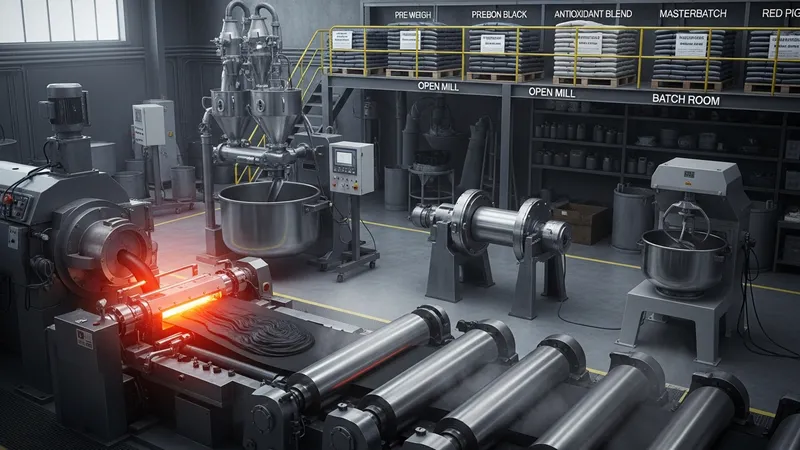
Typical production workflows include raw material receiving and pre-weighing, staged feeding into the mixer, discharge to intermediate storage or immediate shaping, and post-mixing quality checks. In high-volume operations, continuous mixing and inline extrusion or calendering can reduce handling steps and improve cycle-to-cycle consistency. For smaller or specialized runs, batch mixers and open mills may provide necessary flexibility. Inventory control and recipe documentation are commonly used to support reproducible outputs across shifts and suppliers.
Maintenance practices often focus on predictable wear items and contamination control: periodic inspection and replacement of rotor edges, roll covers, seals, and hydraulic fluids; checks for cooling channel blockages; and verification of sensor calibration. Planned downtime windows for preventive maintenance can reduce unplanned failures, and condition monitoring—tracking variables like bearing temperature or drive vibration—may support longer-term reliability. Safety routines, including lockout-tagout and guarding checks, typically form part of standard operating procedures.
Regulatory and environmental considerations include control of particulate emissions during handling of fillers, management of wastewater from cleaning and cooling systems, and documentation for substances of concern where applicable. When scaling operations or changing formulations, conducting material compatibility and process risk reviews can inform equipment adjustments and protect product quality. For readers continuing to other resources, later materials often address specific machine models, laboratory methods, and plant layout considerations in greater depth.