
Managed detection and response (MDR) refers to a set of services and processes that focus on ongoing detection, investigation, and coordinated response to cybersecurity threats across an organisation’s network and endpoints. MDR typically combines continuous monitoring of telemetry, security analytics that correlate signals from multiple sources, and human-led investigation to determine whether an observed activity is malicious. The approach often integrates endpoint visibility, network logs, cloud telemetry, and identity information so analysts can build context and assess risk without relying solely on automated alerts.
Key components often include a remote security operations capability, threat intelligence feeds, and documented response workflows that may be executed by the provider or by an internal team working with alerts. MDR services usually accept telemetry from existing tools such as endpoint agents, network sensors, and log collectors, and they may enrich raw data with external indicators. The intent is to detect attacks more quickly than standalone tooling by combining automated detection with expert review and coordinated response actions when incidents are confirmed.

Endpoint detection agents often provide the immediate visibility that enables many MDR workflows. These agents may capture process execution, file hashes, network connections, and other runtime events that analysts use to reconstruct an attack chain. In practice, the quality and configuration of agents can affect the volume of telemetry and the types of detection that are possible. Organisations considering MDR-focused telemetry frequently weigh coverage across all devices, the agent’s resource footprint, and compatibility with cloud or virtualised environments, since these factors may influence detection fidelity and analyst investigative options.
SOC-led threat hunting and analyst review typically supplement automated alerts with manual investigation. Analysts may validate whether a correlated signal corresponds to benign activity, misconfiguration, or a genuine compromise. Human review can help reduce false positives by applying contextual knowledge such as asset criticality, recent changes, and known maintenance windows. This process often follows a triage model where initial indicators are escalated through defined severity levels and documented with timelines and evidence to support containment decisions and eventual remediation planning.
SIEM and XDR analytics play a central role in correlating telemetry across endpoints, network logs, cloud services, and identity systems. These platforms often normalise disparate logs and apply detection rules or statistical models to identify anomalous patterns. Where present, threat intelligence feeds and indicators of compromise (IOCs) may enrich events to prioritise likely malicious activity. Correlation logic can reveal multi-stage campaigns that single-source detections might miss, and analytics may be tuned over time to reflect organisational baselines and reduce noisy alerts.
Automation and orchestration are commonly used to scale certain response actions while preserving a human-in-the-loop for complex decisions. Automation may execute routine containment tasks — such as network isolation of a compromised host, disabling a user account, or collecting a forensic image — while analysts validate the scope and impact. Careful design of automated playbooks can reduce response time, but these playbooks typically include safeguards and escalation points so that actions with broad impact are reviewed before execution.
Metrics and reporting within an MDR context often focus on detection timelines, analytic accuracy, and the organisation’s ability to contain incidents. Typical metrics may include mean time to detection and mean time to respond, as well as counts of confirmed incidents and the proportion of alerts requiring manual escalation. Reporting also can provide visibility into recurring patterns, such as frequent phishing vectors or common misconfigurations, which may inform longer-term risk-reduction efforts. The next sections examine practical components and considerations in more detail.
Telemetry sources form the foundation of how MDR services identify potential compromise. Common sources include endpoint agents, network flow records, DNS logs, cloud platform logs, and identity provider events. Each source contributes distinct signal types: endpoints show process and file activity, network logs indicate lateral movement or data exfiltration patterns, and identity logs reveal authentication anomalies. Combining these signals often allows analysts to correlate an initial foothold with subsequent reconnaissance or lateral movement, which may be harder to detect when sources are evaluated in isolation.

Endpoint coverage is frequently a priority because many attacks begin on user devices. Agents that capture process trees, command lines, loaded modules, and file creation events may enable detailed reconstruction of attacker activity. However, agent deployment across diverse operating systems and legacy systems can be challenging, and gaps in coverage may limit investigative depth. Organisations often evaluate telemetry completeness alongside agent performance impacts, balancing visibility needs against potential operational constraints on managed devices.
Network and cloud telemetry often supplement endpoint data and may reveal activities that endpoints do not capture, such as suspicious external connections or unusual API calls. For cloud-native workloads, audit logs and platform-native telemetry can provide evidence of lateral access or misused credentials. In mixed environments, correlating identity and cloud logs with endpoint events can clarify whether an anomalous process correlates with a compromised account or a misconfigured service, aiding in accurate triage and response planning.
Coverage decisions also influence privacy and data management considerations. Detailed telemetry can include sensitive information, so organisations and service providers commonly apply collection policies, retention limits, and redaction rules to align monitoring with legal and privacy requirements. Designing telemetry collection and storage with data minimisation and role-based access reduces exposure while preserving the investigative value analysts need to validate and contain incidents.
Detection methods within MDR typically span rule-based signatures, behavioural analytics, and statistical or machine-learning models. Rule-based detections identify known patterns such as specific malware signatures or suspicious command sequences, while behavioural analytics seek deviations from established baselines, such as unusual process creation rates or atypical network destination patterns. Machine-learning techniques may surface anomalies that do not match predefined rules, but they often require tuning and context to reduce false positives and align with the organisation’s normal activity patterns.
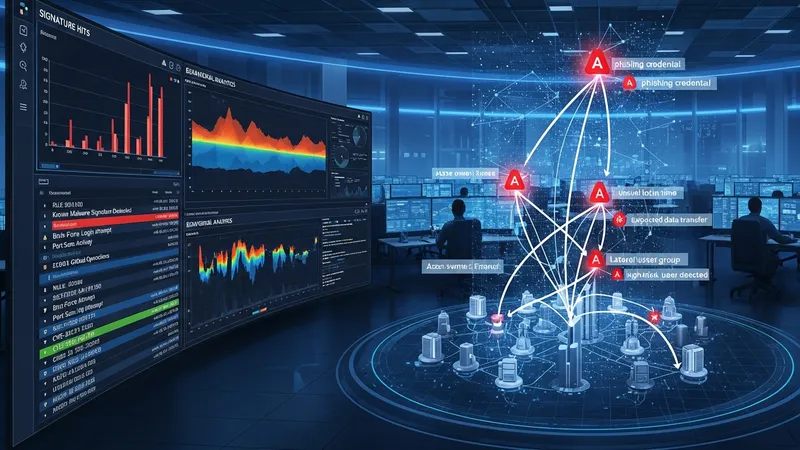
Correlation engines in SIEM or XDR systems help connect discrete alerts into coherent hypotheses about multi-stage intrusions. For example, a sequence that includes a phishing-induced credential use, followed by unusual login times and unexpected data transfers, can indicate an escalating compromise. Correlation often relies on enrichment with contextual attributes such as asset owner, business unit, and known vulnerabilities, which may help prioritise investigations based on potential impact rather than alert volume alone.
False positives and alert fatigue are practical concerns for detection operations. High volumes of low-fidelity alerts can divert analyst time from meaningful investigations. MDR approaches commonly include iterative tuning, where detections are refined based on feedback from investigations, and suppression rules are applied for known benign patterns. Additionally, analysts may maintain white-lists and contextual allowlists for scheduled processes or known maintenance activities to reduce unnecessary escalations.
Threat intelligence can augment detection by associating observed indicators with known adversary infrastructure or tactics. Intelligence may come from open-source feeds, commercial providers, or industry sharing groups, and it often helps prioritise alerts for investigation. However, reliance on external indicators requires validation because IOCs can be recycled or noisy; combining intelligence with local context tends to yield more actionable signals than standalone IOC matches.
Investigation workflows in MDR generally follow a progression from triage to containment, eradication, and recovery. Triage involves assessing initial alerts to determine credibility and potential scope, often using enriched telemetry to map affected hosts, user accounts, and data flows. Containment actions may be recommended or executed to prevent further spread, such as isolating endpoints or blocking command-and-control domains at the network edge. These steps are typically documented to preserve evidence and enable coordinated follow-up activities.

Forensic collection practices are important when investigators need to establish root cause or prepare evidence for regulatory reporting. Forensic steps may include capturing volatile memory, collecting disk images, and preserving relevant logs with timestamps. Proper chain-of-custody practices and secure storage of collected artefacts facilitate later analysis or external review by legal or regulatory stakeholders. MDR providers often describe these capabilities as part of their operational model to indicate how they support deeper investigations when necessary.
Response playbooks are structured procedures that outline typical containment and remediation options for common incident types, such as credential compromise or ransomware. Playbooks may include conditional branches depending on asset criticality or the presence of sensitive data. While automation can execute routine steps from these playbooks, complex incidents usually require human coordination, clear escalation paths, and cross-functional involvement from IT, legal, and operations teams to manage impact and recovery.
Communication and reporting are routine aspects of MDR incident work. Analysts typically provide timelines, evidence summaries, and recommended next steps to the organisation’s stakeholders. Regular incident summaries can help organisations understand attack trends and recurring gaps, supporting longer-term remediation such as patching programs, configuration changes, or targeted user awareness activities. These reports tend to focus on factual findings and suggested mitigations rather than prescriptive mandates.
MDR services can be delivered through several operational models, including fully managed services, co-managed arrangements, or advisory support for in-house teams. In fully managed models, the service provider handles monitoring, investigation, and response actions according to pre-agreed processes. Co-managed models allow internal teams to retain operational control while receiving analyst support. Each model may suit different organisational risk profiles, resource availability, and compliance needs, and choices often balance control with access to specialist expertise.

Staffing and skill composition in MDR operations normally include level-1 triage analysts, level-2 investigators, and senior threat hunters or incident responders. Access to specialised skill sets such as malware analysis, cloud forensics, or threat hunting is often cited as a reason organisations engage external MDR capabilities. Workforce constraints and retention challenges mean that some organisations may prefer managed or co-managed models to supplement internal capability gaps without committing to long-term hiring in specialist roles.
Performance metrics commonly used to evaluate MDR effectiveness include mean time to detect (MTTD), mean time to respond (MTTR), and the rate of confirmed incidents versus total alerts. These metrics may be presented as ranges or trends rather than absolute targets, and organisations often track them alongside contextual measures such as asset criticality and incident severity. Regular reviews of these metrics can inform tuning of detection logic, staffing adjustments, or shifts in the operational model to better align with changing threat patterns.
Contractual and compliance considerations often influence MDR arrangements. Service level agreements (SLAs) may define expected response windows for different severity levels, reporting cadences, and data handling obligations. Organisations also consider regulatory requirements for data sharing and breach notification when selecting operational approaches. Reviewing contractual terms and aligning them with internal incident response plans helps ensure that MDR collaboration supports regulatory and governance needs without creating ambiguity in roles or responsibilities.