
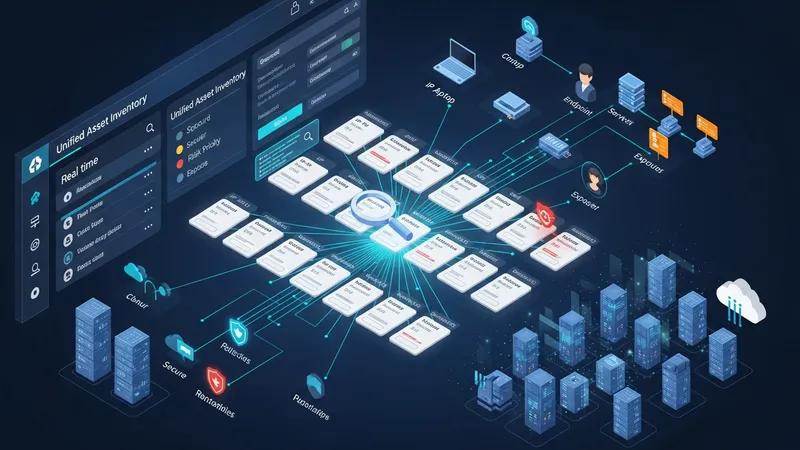
Cyber Asset Attack Surface Management (CAASM) is a systematic approach to maintaining an organized view of an organization’s digital assets and their exposure to potential threats. It centers on consolidating disparate sources of asset information—cloud inventories, endpoints, network devices, identities, and software instances—into a unified inventory. CAASM systems aim to make asset attributes, relationships, and contextual metadata discoverable so that security teams can assess configuration drift, dependencies, and external exposure across hybrid and multi-environment deployments without presuming any single deployment model.
In practice, CAASM complements other security functions such as vulnerability management, identity governance, and security monitoring by providing a consistent asset model and authoritative inventory. It typically focuses on continuous discovery, normalization of asset data, mapping identities to resources, and enabling queryable visibility for analysis. CAASM outputs may feed into risk prioritization workflows, reporting, and security orchestration tools, while remaining an operational layer that updates as environments change.
Different discovery approaches may suit different environments and risk profiles. Agent-based discovery can provide detailed, host-level telemetry including installed software and local configuration, which may often improve fidelity for on-premises hosts. Cloud API aggregation typically exposes resource metadata and IAM configurations that are relevant to cloud exposures. Passive network discovery can be useful in segmented networks or for transient devices where installing agents is impractical. Each method may produce overlapping and inconsistent records that require reconciliation and careful handling of stale or duplicate entries.
Data normalization and asset-model design are central operational challenges. Asset sources commonly use varying identifiers and attributes; reconciling hostnames, IPs, instance IDs, or service names often requires deterministic or probabilistic correlation rules. Asset records can include relationships—such as host-to-application mapping or identity-to-resource associations—that may be represented as graphs to improve queryability. Maintaining timestamping, provenance metadata, and confidence scores for each attribute can help downstream consumers understand when entries were last validated and how reliable each source may be.
Integration with vulnerability, configuration, and identity datasets is where CAASM typically provides practical value. By linking asset records to vulnerability scanner outputs, configuration baselines, and identity management data, teams can contextualize exposures. For example, an internet-facing service identified through passive discovery may be associated with a cloud instance and a set of IAM roles, which could then be examined alongside known vulnerabilities or misconfigurations. These cross-references often inform prioritization but should be used as contextual inputs rather than definitive risk judgments.
Operationalizing CAASM requires attention to governance, role definitions, and lifecycle processes that often vary by organization size. Establishing data ownership for asset records, defining acceptable synchronization frequencies, and setting rules for decommissioning or archival of assets can reduce inventory drift. CAASM outputs may feed dashboards, tickets, or automated playbooks, yet organizations typically find value in human review loops for ambiguous correlations. Measuring coverage, asset classification accuracy, and time-to-detection for new assets can serve as practical metrics for continuous improvement.
In summary, CAASM is a systems-level practice that seeks to consolidate asset visibility, map relationships, and support informed security decision-making through continuous discovery and normalization. It typically complements existing security tools by offering an authoritative inventory layer that other functions may consume. The next sections examine practical components and considerations in more detail.
Asset discovery methods in CAASM commonly fall into complementary categories that together improve coverage. Agent-based collection may provide granular host and application data and typically enables richer telemetry per endpoint. API-based collection from cloud providers often yields resource metadata such as instance identifiers, service configurations, and role bindings, which can inform cloud exposure analysis. Passive network techniques can reveal ephemeral or unmanaged devices that do not host agents. Combining these approaches can often reduce blind spots, while organizations should consider trade-offs related to deployment overhead, data volume, and privacy constraints when selecting discovery methods.
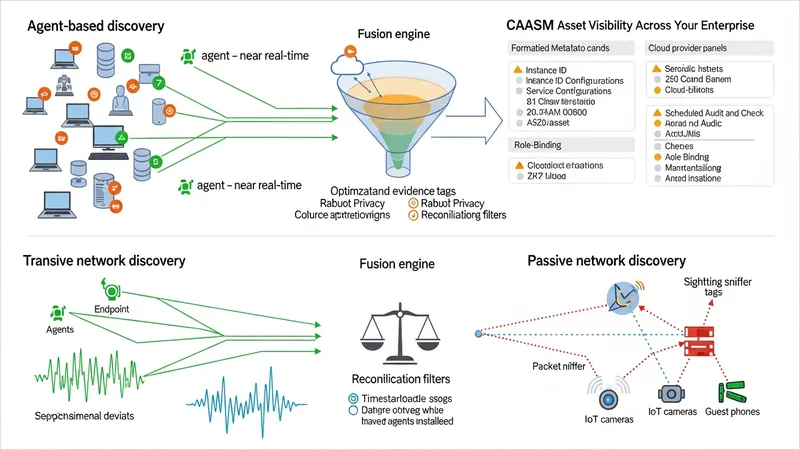
When choosing discovery mixes, an important consideration is data freshness and synchronization cadence. Agent telemetry may be near real-time for active hosts, while cloud APIs may reflect eventual consistency and periodic updates. Passive network observations can be transient and require correlation with additional sources to avoid false positives. Organizations often maintain timestamped evidence and source attribution for each discovered attribute so that consumers can assess recency. Planning for reconciliation rules and deduplication logic often reduces noise and supports clearer asset lineage for later analysis.
Operational constraints such as segmented networks, intermittent connectivity, and remote or IoT devices can affect discovery effectiveness. In such contexts, passive or network-based discovery can surface devices that are not reachable by agents, while periodic endpoint sweeps or jump-host approaches may be used to augment coverage. Privacy, compliance, and data minimization considerations can restrict certain collection techniques; documenting acceptable collection scopes and retention periods often helps balance visibility against policy requirements. These operational details commonly inform phased deployment strategies for CAASM.
As discovery feeds accumulate, consideration of asset classification becomes important for downstream use. Classifying assets by environment, criticality, exposure (e.g., internet-facing), and ownership can help prioritize review efforts. Many organizations adopt simple classifications initially and refine categories over time as more contextual data becomes available. Clear tagging conventions and alignment with existing inventory or CMDB structures can reduce friction between CAASM outputs and other operational systems, often making integration smoother.
Inventory normalization converts heterogeneous asset records into a consistent schema that can be queried and linked. Sources often use different identifiers—IP addresses, hostnames, instance IDs, or UUIDs—and normalization may apply deterministic joins or probabilistic matching to correlate records. Data models that include attributes, relationships, provenance, and confidence scores can make inventories more useful for analysts. Graph-oriented models frequently represent relationships explicitly, enabling queries that traverse identity-to-resource or service-to-host connections and supporting impact analysis during incident response scenarios.
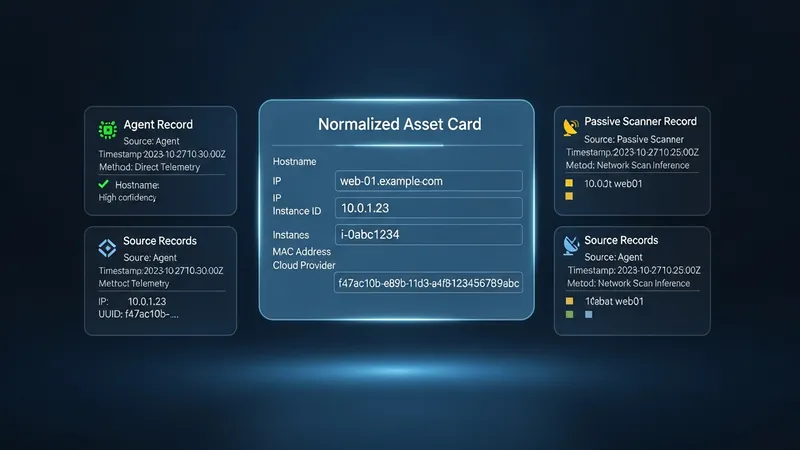
Provenance metadata is an important component of normalization workflows. Recording the original source, collection timestamp, and method of inference helps downstream users assess reliability. Confidence scoring can be applied when data is merged from conflicting sources; for example, agent data may be assigned higher confidence for local configuration items, while passive discovery may carry moderate confidence for service presence. These design choices often depend on threat model priorities and available validation mechanisms.
Duplicate detection and lifecycle handling prevent inventory bloat and stale records. Implementing rules for merging records, deactivating assets that have not been seen for defined intervals, and archiving historical snapshots can maintain operational clarity. Versioning of asset records may support temporal queries, such as determining the configuration state at a specific point in time for forensic or compliance purposes. These practices typically improve the utility of a CAASM inventory as a source of truth.
Interoperability with other data sources often requires standardized formats or connector frameworks. Exporting normalized asset data via APIs, message queues, or file exports enables downstream systems—vulnerability scanners, SIEMs, or IT service management platforms—to consume consistent information. Defining clear API contracts and minimal viable schemas can help integration efforts scale. Considerations such as rate limits, authentication, and access control should be treated as part of the normalization and distribution design to maintain operational reliability.
Risk identification within CAASM typically involves correlating asset inventory with vulnerability, configuration, and exposure data. An inventory record may be linked to recent vulnerability scanner findings, configuration baseline deviations, or publicly visible services. Prioritization often considers asset criticality, business impact, and exploitability indicators rather than relying solely on severity scores. This contextual approach can help teams focus on assets where remediation may most effectively reduce organizational exposure, while acknowledging uncertainty and the need for further validation where correlations are inferred.
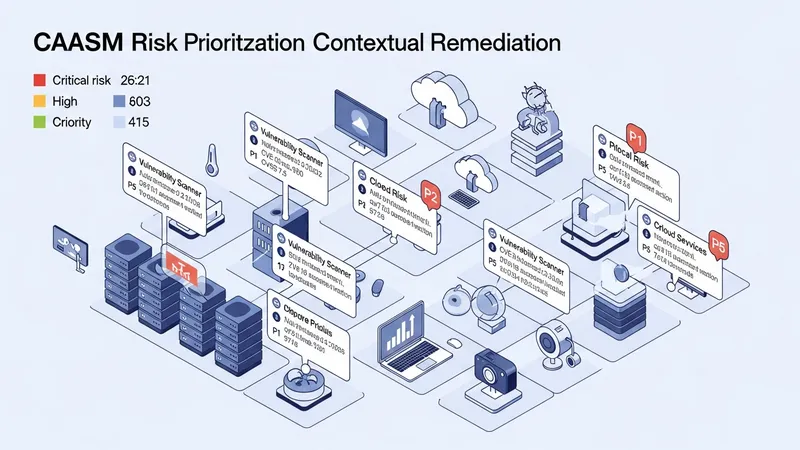
Vulnerability and threat intelligence integration can provide signals that adjust prioritization. For example, the presence of a publicly disclosed exploit targeting a specific software component may raise urgency for affected assets that are internet-exposed. Similarly, configuration drift that opens remote management ports could increase exposure. These signals are typically combined with asset owner information and operational constraints to determine feasible remediation timelines, recognizing that practical constraints often necessitate staged mitigation strategies.
Scoring and metric design are areas where CAASM outputs are often translated into operational guidance. Metrics such as coverage percentage, mean time to detect new assets, and proportion of assets mapped to an owner may be tracked. Prioritization frameworks may use weighted factors—business criticality, exposure, vulnerability severity—to rank remediation tasks. These frameworks often require periodic tuning and validation to ensure they reflect organizational priorities and do not overemphasize any single input source.
Uncertainty management is a recurring theme in risk workflows. When asset records contain ambiguous identifiers or low-confidence correlations, teams may flag items for verification rather than immediate classification. Including human-in-the-loop review gates, evidence collection procedures, and clear escalation paths can reduce the risk of incorrect prioritization. These controls often help balance automation benefits with the need for accuracy in producing actionable risk insights.
Continuous management in CAASM emphasizes sustaining inventory accuracy and ensuring asset records remain current as environments evolve. Integration points often include automated connectors to cloud providers, identity systems, endpoint management platforms, and vulnerability scanners that run on schedules appropriate for each source. Change events—such as cloud instance creation or deprovisioning—may trigger inventory updates. Organizations typically plan for incremental rollouts of such integrations and establish monitoring to detect synchronization failures or anomalous data trends.
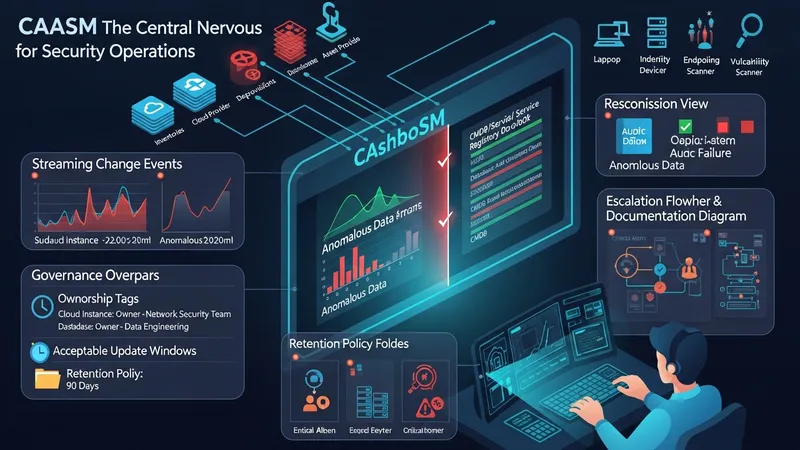
Governance practices help maintain CAASM effectiveness over time. Defining ownership for asset classes, specifying acceptable update windows, and recording retention policies for asset data contribute to predictable operations. Regular audits or reconciliation processes—comparing CAASM output against CMDB entries or service registries—can surface systemic gaps. Documentation of data flows and escalation procedures can also reduce confusion when asset discrepancies arise, supporting more timely corrective actions.
Automation can accelerate routine tasks such as deduplication, tagging, and evidence collection, yet organizations often balance automation with human review for ambiguous cases. Automation rules typically include thresholds and fallback paths to prevent erroneous updates to authoritative records. When automations modify asset metadata or trigger tickets, including context and provenance in the generated output often helps operators evaluate and act on the information more efficiently, reducing the likelihood of misinterpretation.
Measuring CAASM program health commonly involves tracking coverage, data quality, and responsiveness to change. Coverage may be assessed by the proportion of known asset classes represented in the inventory, while data quality may be gauged by correlation accuracy and update recency. Monitoring trends over time and conducting periodic reviews helps identify opportunities to refine collection methods, normalization rules, and integration points. These measures often support steady improvements in visibility and operational confidence without implying absolute completeness.