
AI medical billing refers to the application of machine learning, natural language processing, optical character recognition, and related automation techniques to tasks within clinical billing and claims management. The approach typically addresses activities such as preparing and submitting claims, mapping clinical documentation to billing codes, identifying mismatches or omissions, and organizing records for payment posting. Systems described as AI medical billing may combine pattern recognition with business rules to interpret structured and unstructured data from clinical notes, electronic health records (EHRs), and payer responses, with the objective of making clerical and analytic tasks more consistent and traceable.
In practice, AI medical billing systems interface with existing practice management and EHR software to ingest encounter-level data, determine probable charge codes, and suggest corrections or additional documentation needs. Algorithms may flag likely denials, assign a probability score to claim acceptance, or group rejections by root cause for human review. These technologies often operate alongside traditional rule-based claim scrubbing and human expertise, so outcomes are typically described as reductions in manual sorting and faster identification of common coding or submission issues rather than guaranteed results.
One way to view automated claims processing is as a layered model: data capture (OCR, structured export), clinical-to-billing translation (NLP, mapping), claim validation (rules engine, payer rules), and performance feedback (analytics). Each layer may be provided by separate modules or an integrated platform. For example, capture technologies may convert scanned documents into text that an NLP model then annotates for relevant billing concepts. The validation layer typically applies payer rules and common-sense checks to reduce trivially rejectable submissions, while analytics measure throughput and recurring error types.
Rule-based engines and machine learning components often coexist in contemporary implementations. Rule-based logic can encode explicit payer requirements and deterministic checks that are easy to interpret, while machine-learned models may identify patterns of human error or complex associations in denial data that rules do not capture. In many settings, governance frameworks require that outputs from probabilistic models be explainable and subject to human review, especially where coding choices affect reimbursement or compliance. This hybrid approach may help organizations balance efficiency and auditability.
Denial management and error detection are common focus areas for automation. Automated systems can categorize denials by likely cause — missing authorization, coding mismatch, or eligibility issues — which may speed triage and appeal preparation. Payment posting automation may normalize remittance advice information and reconcile expected versus actual payments. However, practical deployment typically involves iterative tuning of models and exception-handling workflows so that automated classifications align with the organization’s documentation and billing policies.
Adoption of AI features in billing workflows often prompts closer attention to data quality and standardization. Performance of NLP and learning algorithms usually depends on consistent clinical documentation and accurate mapping between clinical concepts and billing terminologies. Organizations may therefore invest in documentation templates, staff training, or integration work to improve inputs. These measures frequently complement automation and may influence how much manual effort is reallocated versus eliminated.
In summary, AI medical billing encompasses a set of technologies that may automate portions of claims management, support coding decisions, and surface patterns in denials and payments. Implementations commonly layer data capture, NLP-based mapping, rule-based validation, and analytics, with human oversight retained for exceptions and compliance review. The next sections examine practical components and considerations in more detail.
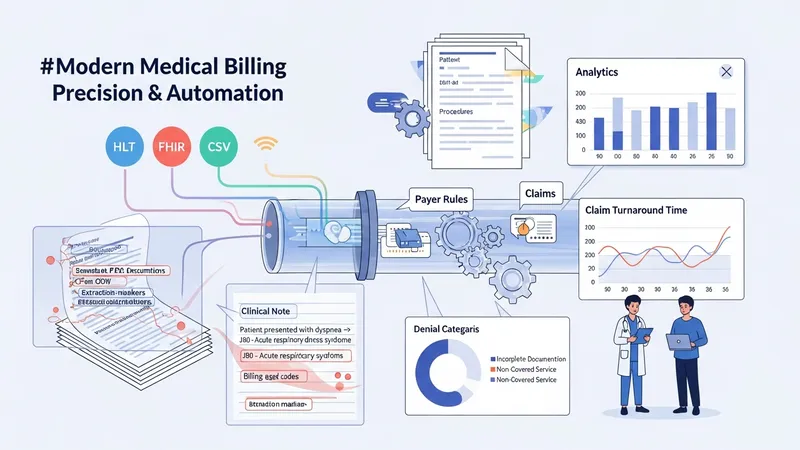
Core components of automated medical billing systems typically include data ingestion, transcription or OCR, NLP for clinical concept extraction, a rules engine for payer requirements, and analytics for monitoring. Data ingestion may accept HL7, FHIR, CSV exports, or direct database connections from an electronic health record; OCR may handle PDFs and scanned documents. NLP models can convert narrative notes into candidate codes or highlight documentation gaps. Rules engines often encode payer-specific logic, and analytics tools aggregate metrics such as claim turnaround times and common denial categories to guide optimization.
Optical character recognition and structured data feeds address different input types and often coexist. OCR is valuable for legacy or paper-driven workflows, while structured feeds from modern EHRs reduce the need for text extraction. When models rely on narrative interpretation, consistent documentation styles typically improve accuracy. Teams evaluating components commonly consider explainability, interoperability with existing software, and the ability to manage updates to payer rules without extensive reprogramming.
Machine learning components used for classification or prioritization usually require labeled training data drawn from prior claims and remittance outcomes. Model performance may vary by specialty and documentation style, so organizations commonly retrain or fine-tune models on local data. Where possible, retaining human review of uncertain classifications and maintaining audit logs for automated decisions supports oversight, troubleshooting, and compliance with data governance expectations.
When planning a deployment, stakeholders often weigh integration complexity, expected throughput gains, and ongoing maintenance needs. Practical considerations include the frequency of payer rule changes, availability of labeled historical data, and staff capacity to handle exceptions. Documenting these factors and establishing feedback loops between billing staff and system owners may help align automation behaviors with operational realities.
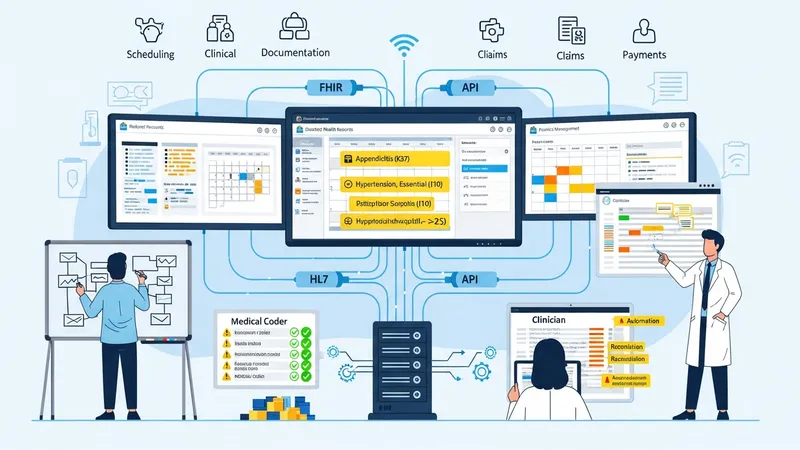
Workflow integration commonly determines the practical impact of automation on claims management. Systems that connect directly to scheduling, clinical documentation, and practice management platforms can surface coding suggestions earlier in the encounter lifecycle, which may reduce post-encounter rework. Typical integrations use standard APIs or file-based exchanges; maintaining consistent identifiers across systems is essential for accurate linking of encounters, claims, and payments. Interoperability choices often affect latency, error rates, and the ease of reconciling automated outputs with human workflows.
Standards-based interfaces such as FHIR and HL7 may facilitate structured data exchange but are not universally implemented across all providers and vendors. Where standards are absent, organizations may rely on custom connectors or middleware, which can introduce maintenance overhead. Data normalization — aligning terminology, provider identifiers, and payer codes — often improves the reliability of automated processes. Teams may therefore allocate effort to mapping and transformation logic early in a deployment to reduce downstream mismatches.
Integration planning also involves designing exception workflows for claims that an automated process flags as uncertain or high risk. Typical patterns preserve human-in-the-loop review for these exceptions while allowing routine claims to flow through automated validation. Establishing clear escalation paths, assigning ownership for exception resolution, and maintaining traceable decision records help ensure that automated actions are auditable and that learning from resolved exceptions can be fed back into model tuning or rule updates.
Data governance considerations influence both integration and ongoing operation. Access controls, audit trails, and change-management processes for payer rules or model parameters are commonly part of implementation roadmaps. Organizations often find that balancing ease of integration with rigorous controls results in more sustainable automation, with documented interfaces and versioned rule sets supporting both efficiency and accountability.
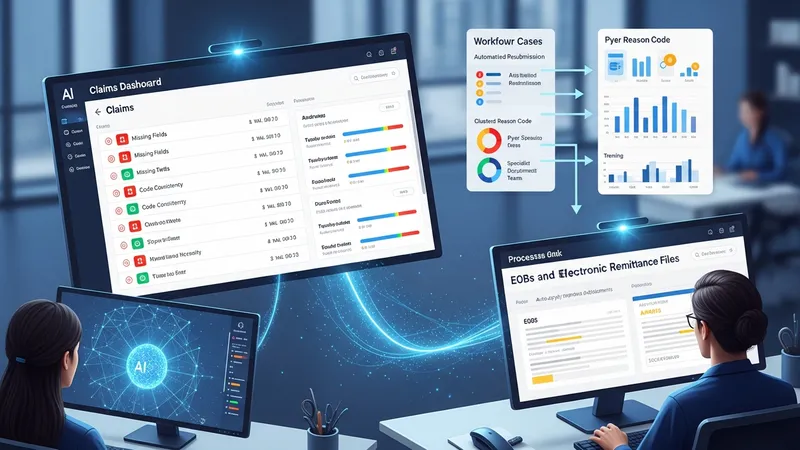
Error detection in automated billing systems typically combines syntactic checks (missing fields, format errors) with semantic checks (coding consistency, medical necessity indicators). Automated denials analysis often groups payer responses by reason codes, enabling trends to be identified and addressed. Predictive models may estimate the likelihood that a claim will be denied, which can inform prioritization of appeals or pre-submission remediation. These approaches generally aim to reduce repetitive manual sorting and focus staff attention where it may be most impactful.
Denial management workflows supported by automation may include automated claim resubmission where simple corrections are clear, or routing to specialized staff for complex appeals. Payment posting automation commonly parses explanation of benefits or electronic remittance files, applies payments to patient accounts, and records adjustments. Accuracy of remittance parsing can vary with the format and quality of payer files, so iterative validation and exception monitoring are often part of the early deployment phase.
Root-cause analysis facilitated by analytics can reveal recurring issues such as authorization lapses, incorrect provider identifiers, or consistent documentation gaps. Identifying these patterns may inform process changes, coding education, or adjustments to templates. Rather than viewing automation as a one-off fix, many organizations treat it as a diagnostic tool that surfaces systemic issues needing human-led process improvements and governance interventions.
Human oversight remains an important consideration in denial and payment processes. Systems that allow reviewers to annotate automated classifications and feed corrected outcomes back into model training may improve long-term accuracy. Maintaining clear documentation of why an automated decision was overridden and periodically auditing samples of automated actions are common practices to ensure reliability and regulatory defensibility.
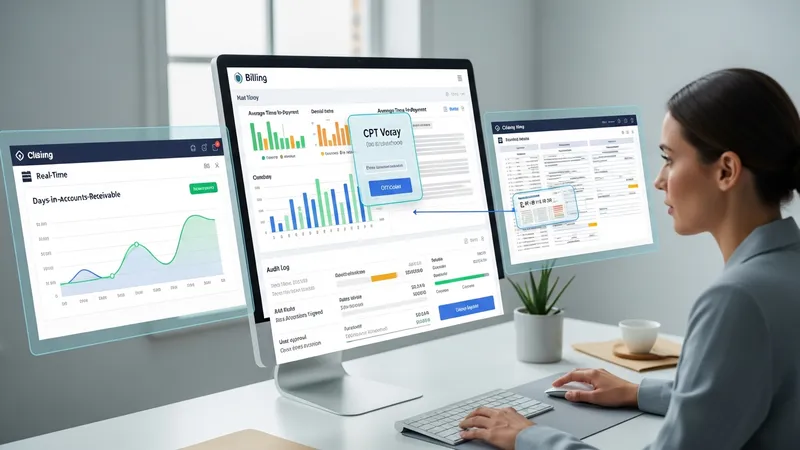
Automation in billing has implications for compliance and reporting, since coding and submission activities are subject to auditing and regulatory scrutiny. Automated systems typically generate logs that record rule applications, model confidence levels, and user actions, which can support audits and internal reviews. Reporting tools may consolidate metrics such as days in accounts receivable, denial rates, and average time to payment; these metrics often serve as indicators of where process improvements or additional training may be needed.
Compliance considerations often drive design choices about explainability and retention of documentation. For instance, maintaining an auditable trail that links a suggested code or automated change to the source documentation is commonly required for retrospective review. Privacy and security controls for protected health information must also be applied consistently across automation components, and organizations often document access controls and data lifecycle policies to align with regulatory expectations and internal risk management.
From a revenue cycle perspective, automation may affect upstream and downstream activities: earlier identification of missing documentation can reduce submission delays, and automated categorization of denials can improve recovery focus. Organizations typically monitor key performance indicators to assess whether automation changes correlating with these metrics are sustained. It is common to stage automation rollout so that impact can be measured and adjustments made without disrupting core revenue processes.
When evaluating reporting and compliance features, stakeholders often consider the granularity of logs, the ability to export data for external audits, and the clarity of model explanations. Practical deployment considerations include scheduling regular audits of automated decisions, training staff on reading automated reports, and planning governance meetings to review trends. These practices may help organizations adopt automation while maintaining visibility and control over claims management processes.